First experience using a novel 3D enabled large-area focal pulsed field ablation catheter for ventricular ablation
EP Europace Journal


Abstract
Pulsed-field ablation (PFA) has shown promising data in terms of safety and procedural efficiency for pulmonary vein isolation (PVI). Large-area focal PFA catheter designs might be suitable to deliver deep and durable lesions in ventricular myocardium.
To investigate the dose-response of a novel large-area focal 3D-enabled map and ablate PFA catheter for ventricular ablation in a chronic preclinical swine model.
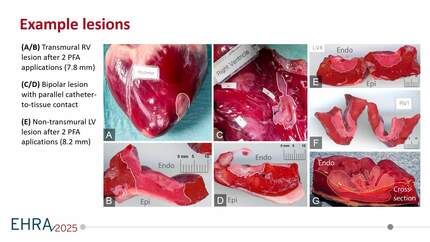
An 8 F large-area focal catheter with a 9 mm hexaspline tip was used for 3D electroanatomical mapping of both ventricles in a porcine model. Using a PFA generator (FARASTAR, Boston Scientific), with a proprietary waveform optimized for the catheter, left- and right-ventricular lesions were placed with either a monopolar or bipolar ablation vector, and with 1, 2, or 4 applications per site (2.0 kV/application). Tissue contact was ensured using intracardiac echography and EGMs. The animals were survived for 1 week. Ablation lesions were assessed macroscopically after triphenyl tetrazolium chloride staining and using histopathology.
A total of 69 chronic ventricular lesions (40, 58% monopolar and 29, 42% bipolar) from 7 pigs were available for analysis. By stacking 4 PFA applications rather than a single application, median chronic lesion depth 7 days after ablation increased from 4.8 mm (IQR 4.1-5.6) to 5.5 mm (IQR 5.0-6.2), p=0.06 with bipolar ablation, and from 4.9 mm (IQR 4.4-5.2) to 6.5 mm (IQR 5.9-6.9), p=0.002 with monopolar ablation. Lesion width ranged from a median of 20.6 mm (Range 11.5-41.6) for a monopolar ablation vector, to 21.9 mm (Range 13.1-39.8) for a bipolar ablation vector. On histology, lesion borders were clearly demarcated, and vessels and nerves preserved.
A novel large-area focal ablation catheter with the ability for high-density 3D mapping and pulsed-field ablation was able to create dose-dependent deep ventricular lesions durable 1 week after ablation.
Contributors

T Kueffer
Author
D Casoni
Author
C Goepfert
Author
O Beslac
Author
C Parodi
Author
D Ramirez
Author
K Garrott
Author
B Koop
Author
S Coe
Author
N Hagstrom
Author
G Gibert
Author
L Roten
Author
A Haeberlin
Author
T Reichlin
Author
You may be interested in