Prevalence of stroke and mortality in patients with atrial tachycardia: insights from the SATELLITE Study Group
EP Europace Journal


Abstract
Atrial tachycardias (AT) are increasingly observed in clinical practice. While catheter ablation has become the therapy of choice, outcome data in these patients are missing.
Here, we aimed to analyze the prevalence of stroke and all-cause death in patients with AT.
SATELLITE (Systematic Assessment of Treatment Effectiveness for Long-Term Management of Stable Atrial Tachycardia in Inpatient and Outpatient Environments) is a multicenter observational registry including patients undergoing catheter ablation or electrocardioversion for AT. In the present analysis, the prevalence of stroke and all-cause death in patients with AT as well as the characteristics of affected patients were assessed. Data acquisition started at the time of AT ablation or electrocardioversion.
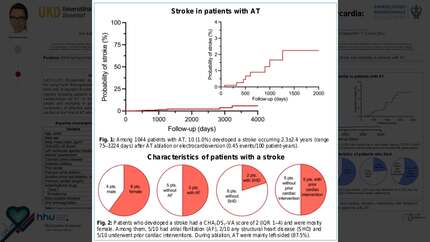
Among 1032 patients with AT (mean age 64.3±14.6 years, 53.5% male), 10 (1.0%) developed a stroke occurring 2.3±2.4 years (range 75–3224 days) after AT ablation or electrocardioversion (0.45 events/100 patient-years). They had a CHA2DS2-VA score of 2 (IQR 1–4) and were mostly female (6/10 patients). Among these patients, 5/10 had simultaneously diagnosed atrial fibrillation, 2/10 any structural heart disease and 5/10 underwent prior cardiac interventions (Fig. A). During catheter ablation, AT were left-sided in the majority of patients who developed a stroke (87.5%). Among all 1032 patients, 21 (2.0%) died mainly due to non-cardiac reasons (72.7%). This occurred 2.4±1.3 years (range 306–2271 days) after AT ablation or electrocardioversion (0.9 events/100 patient-years). Among these patients, 13/21 were female, 12/21 had atrial fibrillation, 5/21 had any structural heart disease and 12/21 underwent prior cardiac interventions (Fig. B).
Whereas the prevalence of stroke in patients with AT is low, the prevalence of all-cause death mainly due to non-cardiac reasons underlines the frequent multimorbidity of this cohort which should be considered especially for planning of ablation procedures. Stroke and mortality in patients with AT

You may be interested in