Is there an association between device-detected atrial fibrillation and diabetes? A propensity score-matched analysis from the Italian Home Monitoring Expert Alliance project
EP Europace Journal


Abstract
Device-detected atrial fibrillation (DDAF) is frequently observed in patients with cardiac implantable devices that allow continuous atrial rhythm monitoring. While some previous studies have found a significant association between clinical atrial fibrillation and diabetes, the relationship between DDAF and diabetes has not yet been investigated.
To compare the incidence of DDAF between patients with and without diabetes, using the propensity score (PS) matching to control for major clinical and demographic confounders.
We extracted data from the Home Monitoring Expert Alliance (HMEA) dataset, identifying all patients with an implantable cardioverter-defibrillator (ICD) or a cardiac resynchronization therapy defibrillator (CRT-D) with atrial monitoring capabilities, and who had no prior history of clinical atrial fibrillation. The primary endpoint was the time to first DDAF episode, evaluated using two duration cutoffs: ≥5 hours and ≥7 days. DDAF-free rates in patients with diabetes at the time of device implantation were compared to those without diabetes, first through an unmatched comparison and subsequently with a PS-matched non-diabetic subgroup.
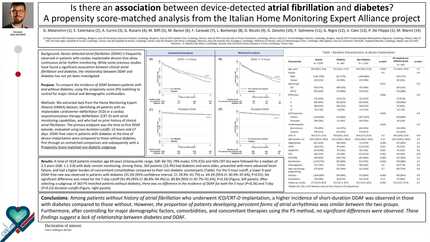
A total of 1619 patients (median age 69 years [interquartile range, IQR: 60-76]; 79% males; 57% ICDs and 43% CRT-Ds) were followed for a median of 2.3 years (IQR: 1.1-3.8) with daily remote monitoring. Among these, 363 patients (22.4%) had diabetes and were older, presented with more advanced heart failure, and had a higher burden of concomitant comorbidities compared to their non-diabetic counterparts (Table). For the 5-hour cutoff, a lower 3-year DDAF-free rate was observed in patients with diabetes (35.3% [95% confidence interval, CI: 28.9%–41.7%] vs. 44.3% [95% CI: 40.9%–47.6%], P=0.01). No significant difference was noted for the 7-day cutoff (91.4% [95% CI: 86.8%–94.4%] vs. 89.8% [95% CI: 87.7%–91.6%], P=0.24) (Figure, left panels). After selecting a subgroup of 363 PS-matched patients without diabetes, there was no difference in the incidence of DDAF for both the 5-hour (P=0.26) and 7-day (P=0.23) duration cutoffs (Figure, right panels).
Among patients without history of atrial fibrillation who underwent ICD/CRT-D implantation, a higher incidence of short-duration DDAF was observed in those with diabetes compared to those without. However, the proportion of patients developing persistent forms of atrial arrhythmias was similar between the two groups. Furthermore, after controlling for major demographic factors, comorbidities, and concomitant therapies using the PS method, no significant differences were observed. These findings suggest a lack of relationship between diabetes and DDAF. Baseline characteristics at implant Survival unmatched and matched analyses
Contributors

G Malanchini
Author
E Celentano
Author
A Curnis
Author
G Rovaris
Author
M Biffi
Author
M Baroni
Author
F Caravati
Author
L Bontempi
Author
D Nicolis
Author
G Zanotto
Author
F Solimene
Author
G Nigro
Author
V Calvi
Author
P De Filippo
Author
M Marini
Author
You may be interested in