Evaluation of qt prolongation in patients following conduction system pacing implantation
EP Europace Journal


Abstract
Conduction system pacing is becoming increasingly popular as a pacing technique; however, its impact on repolarization, particularly on QT interval prolongation, remains unclear.
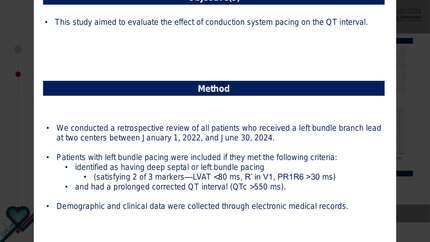
This study aimed to evaluate the effect of conduction system pacing on the QT interval.
We conducted a retrospective review of all patients who received a left bundle branch lead at two centers between January 1, 2022, and June 30, 2024. Patients with left bundle pacing were included if they: identified as having deep septal or left bundle pacing (satisfying 2 of 3 markers—LVAT <80 ms, R’ in V1, PR1R6 >30 ms) and had a prolonged corrected QT interval (QTc >550 ms). Demographic and clinical data were collected through electronic medical records.
From 597 patients who received a 3830 lead, 14 patients with left bundle branch pacing were identified as having QTc >550 ms (mean age 82 ± 6 years, 5 females). Nine patients received their device for complete heart block, 3 for tachy-brady and one after AV [MG1] node ablation. The average ejection fraction was 47 ± 13%. Post-implant ECG analysis showed an average QRS width of 127 ± 14 ms, an average QTc interval of 584 ± 28 ms, and an average heart rate of 74 ± 14 bpm. Notably, one patient experienced Torsades de Pointes three hours post-AV node ablation, with a QT interval of 600 ms that persisted for two weeks post-implant. All patients survived, with a mean follow-up period of 609 ± 470 days.
QT prolongation can occur following the placement of a conduction system pacing lead, which may elevate the risk of Torsades de Pointes post-implantation. In cases of prolonged QT, increasing heart rate may help to reduce the QT interval, though it may not fully normalize it. QT prolongation may persist for more than two weeks post-implant. Clinicians should be mindful of the potential for QT prolongation with conduction system pacing and consider closer follow-up until QT normalizes.
Contributors

M Golian
Author
G Almidani
Author
M Asif
Author
D Fakim
Author
L Ayala Valani
Author
F Ayala Valani
Author
F Ayala-Paredes
Author
You may be interested in