Retrospective observational study of tricuspid regurgitation in patients with device implantation (PM, CRT) in LBBP Position
EP Europace Journal


Abstract
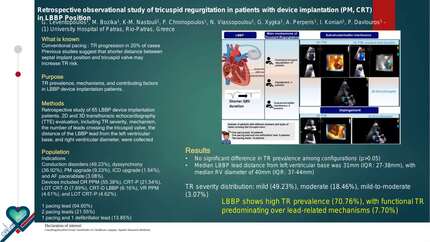
Tricuspid regurgitation (TR) is a common complication after device implantation. While conventional right ventricular pacing shows TR progression in 20% of cases (4-7% severe), left bundle branch area pacing's (LBBP) impact remains understudied. Previous studies suggest that shorter distance between septal implant position and tricuspid valve may increase TR risk.
To investigate TR prevalence, mechanisms, and contributing factors in LBBP device implantation patients.
Retrospective study of 65 LBBP device implantation patients. Echocardiographic data by two-dimensional (2D) and 3-dimensional (3D) transthoracic echocardiography (TTE) evaluation, including TR severity, mechanism, the number of leads crossing the tricuspid valve, the distance of the LBBP lead from the left ventricular base, and right ventricular diameter, were collected.
TR was present in 46 patients (70.76%), predominantly functional due to right ventricular dilation (63.07%). Lead-related mechanisms were less common: lead impingement (4.62%) and subvalvular/leaflet interference (3.08%). Detailed echocardiographic analysis of lead-related TR revealed the following: In three patients, echocardiographic assessment revealed lead impingement of the tricuspid valve leaflets, confirmed by 3D echocardiography. In two patients, lead interference with the subvalvular apparatus was observed. In the first case, the lead was positioned towards the anterior leaflet and became entangled beneath the subvalvular mechanism. In the second case, lead entanglement with the subvalvular apparatus occurred during the implantation procedure, resulting in chordal rupture during attempted lead repositioning, requiring transesophageal echocardiography (TEE) assessment. TR severity distribution: mild (49.23%), moderate (18.46%), mild-to-moderate (3.07%). Lead configurations included single pacing (64.60%), dual leads (21.55%), and pacing plus defibrillator (13.85%), with no significant difference in TR prevalence among configurations (p>0.05). Median LBBP lead distance from left ventricular base was 31mm (IQR: 27-38mm), with median RV diameter of 40mm (IQR: 37-44mm). Implantation indications: conduction disorders (49.23%), dyssynchrony (36.92%), PM upgrade (9.23%), ICD upgrade (1.54%), and AF pace/ablate (3.08%). Devices included DR PPM (55.38%), CRT-P (21.54%), LOT CRT-D (7.69%), CRT-D (6.16%), VR PPM (4.61%), and LOT CRT-P (4.62%). Limitations: Lack of pre-implantation echocardiographic data and direct comparison with conventional RV pacing limits definitive conclusions about LBBP advantages. Additionally, this represents preliminary data from an ongoing study.
LBBP shows high TR prevalence (70.76%), with functional TR predominating over lead-related mechanisms (7.70%). Lead configuration did not significantly impact TR prevalence, suggesting other factors' importance.
Contributors

G Leventopoulos
Author
M Bozika
Author
K M Nastouli
Author
P Chronopoulos
Author
N Vlassopoulou
Author
G Xygka
Author
A Perperis
Author
I Koniari
Author
P Davlouros
Author
You may be interested in