Extraction of novel, small diameter OmniaSecure defibrillation lead from the deep septum in sheep
EP Europace Journal


Abstract
The aim of this study is to preclinically evaluate the extractability of the OmniaSecure lead.
Forty sheep were implanted with 80 leads (2 leads/sheep) for a 5 year extraction study, with 16 leads extracted yearly. Thus far, 32 leads from 16 sheep were extracted at year 1 and 2 using simple traction or market available extraction tools. Among these were 25 OmniaSecure leads, 14 were implanted in a standard RV location and 11 in deep septal locations. As controls, 7 Sprint Quattro leads (6935M) were implanted in a standard RV location. The force required to remove the lead was recorded. Pre- and post-extraction ECG were visually compared for morphology changes. Scar burden from coil to tip was assessed on the extracted lead and assigned a value (1-low, 5-high burden). Animals were monitored for one hour post-extraction. Images of the suspected lead implant location were taken at necropsy and evaluated for tissue damage. Extraction was deemed successful if the lead was fully extracted and there were no complications.
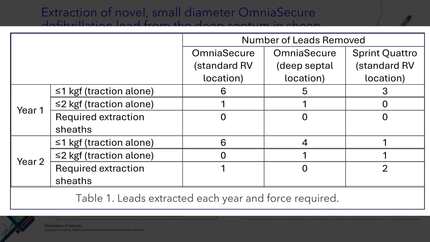
Sixteen leads were extracted from 8 sheep each year (Table 1). Extraction of all OmniaSecure and Sprint Quattro leads was successful at 1 and 2 years. At year 1, extraction was performed for all leads with traction alone (7 OmniaSecure leads from the RV location, 6 from the deep septum, and 3 Sprint Quattro leads from the RV location). At year 2, extraction required the use of a Cook Evolution tool in 2/4 Sprint Quattro leads and 1/8 OmniaSecure leads in the standard RV location. All other leads were removed with simple traction, including all 4 OmniaSecure leads from the deep septum.
Minimal force was required to remove OmniaSecure and Sprint Quattro leads at Year 1 (Table 1). At year 2, extractions trended towards less force for OmniaSecure compared to Sprint Quattro leads. When visually comparing ECGs, a persistent change in the T wave direction was observed in 3 of the 8 animals at year 2, all three of which were extracted from the deep septum. Sprint Quattro had a higher scar burden than OmniaSecure (4.3 vs 2.8) (Figure 1). Upon visual inspection of the implant locations in the dissected RV, leads extracted from the deep septum created more localized tissue damage and bruising than leads extracted from the standard RV (Figure 1); however, all leads from the deep septum were extracted successfully.
These data demonstrate the extractability of OmniaSecure leads through 2 years in large animal models. OmniaSecure leads may offer advantages in clinical lead extraction, including lower lead removal forces and reduced scar burden.
Contributors

You may be interested in