Postoperative antibiotic prophylaxis following cardiac implantable electronic device implantation and the risk of device infection
EP Europace Journal


Abstract
Cardiac implantable electronic devices (CIEDs) are essential for management cardiac arrhythmia. One of the most dismal complications is device infection that may cause significant morbidity and mortality. The current perioperative recommendation includes preoperative intravenous antibiotic prophylaxis, whereas the role of postoperative oral antibiotics is less clear.
To assess the incidence of CIED infections among patients undergoing CIED implantation with and without postoperative oral antibiotics.
This retrospective cohort study included approximately 1,500 patients who underwent CIED implantation at a tertiary university medical center between January 2018 and December 2022. Prior to implantation, all patients received an intravenous dose of Cephazolin or Clindamycin if Penicillin sensitive. Patients were divided into two groups: those who received postoperative oral antibiotics and those who did not. The antibiotics administered included a regimen of Amoxicillin and Clavulanic acid for 3 to 5 days or Clindamycin for patients with Penicillin sensitivity. Patients who required antibiotics for other reasons, patients with immune deficiencies, and those with incomplete follow-up data were excluded. The primary outcome was the rate of superficial skin infections, pocket infections, and endocarditis/bacteremia within six months post-implantation. Statistical analyses were performed using univariate analysis, followed by multivariable logistic regression modeling to adjust for confounding factors. Kaplan-Meier survival analysis was used to compare infection-free survival rates between the two groups.
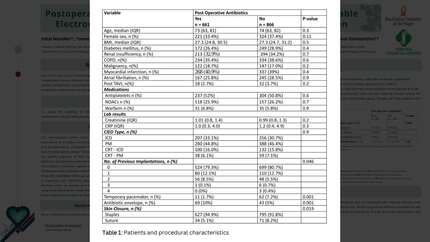
The study included 1527 consecutive patients: 661 who received postoperative oral antibiotics, and 886 who did not. Mean age was 73 years and 35% were females. Diabetes, COPD and past myocardial infarction were the most common comorbidities. Approximately 80% had their first implantation whereas 20% underwent device replacement or revision. The distribution between pacemaker and implantable-cardioverter-defibrillator implantations was almost equal (Table 1). Infection rate was 1.3% in the no-antibiotic group and 2.1% in the antibiotic group, without a significant difference between the groups (p = 0.19) (Figure 1). There were 3 cases of skin infections (0.4%), 5 pocket infections (0.5%), and 3 cases of endocarditis/bacteremia (0.4%), compared to 8 skin infections (1.2%) and 5 cases of pocket infections (0.9%) in the no-antibiotic vs. antibiotic groups respectively.
The rate of CIED infections through 6 months after implantation was relatively low without a significant difference between the two groups. Given the global concern over antimicrobial resistance, a more selective approach of postoperative antibiotic therapy should be considered, with an emphasis on preoperative prophylaxis, as recommended by current guidelines. Larger, prospective studies are needed to validate this hypothesis. Kaplan-Meier and Infection Rates Patient Demographics
Contributors

I M Mandler
Author
T K Krutic
Author
O B Biham
Author
I H Hazan
Author
V K Novak
Author
D G Grupel
Author
M H Haim
Author
Y K Konstantino
Author
You may be interested in