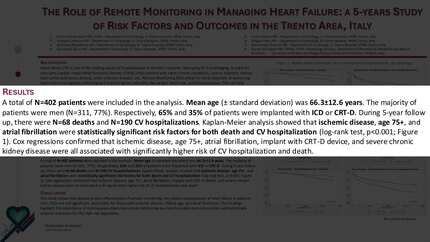
The role of remote monitoring in managing heart failure: a 5-years study of risk factors and outcomes in the Trento area, Italy
EP Europace Journal


Abstract
Heart failure (HF) is one of the leading causes of hospitalization in patients aged 65 years and older in Western countries. Managing HF is challenging, as patients who carry cardiac implantable electronic devices (CIEDs) often present with other chronic conditions, such as diabetes, chronic obstructive pulmonary disease, osteo-articular diseases, etc. Remote monitoring (RM) allows for early detection of worsening heart failure by regularly collecting and monitoring key indicators like weight, heart rate, and blood pressure. This can help patients and physicians adjust therapy or intervene promptly in case of anomalies, thereby improving clinical outcomes.
The aim of this study was to assess the clinical consequences of remotely monitored patients, treated with implantable cardioverter-defibrillators (ICDs) or cardiac resynchronization therapy defibrillators (CRT-Ds) followed up for 5 years. The analysis was focused on survival and cardiovascular (CV) hospitalizations and evaluated the risk factors connected to these events.
Clinical data were extracted from the Electrophysiology Registry of Cardiology Unit, which has been systemically collecting patient information since 2011. Patients with implantable devices and monitored remotely were assessed for their clinical characteristics (e.g. gender, age, type of implanted device, comorbidities). Incidence and time to death and/or CV related hospitalizations were evaluated.
Univariate survival analyses were conducted by patient characteristics (presence of ischemic disease, age over 75, atrial fibrillation and device type). Additionally, multivariate survival analysis was conducted through Cox regression.
A total of N=402 patients were included in the analysis. Mean age (± standard deviation) was 66.3±12.6 years. The majority of patients were men (N=311, 77%). Respectively, 65% and 35% of patients were implanted with ICD or CRT-D. During 5-year follow up, there were N=68 deaths and N=190 CV hospitalizations. Kaplan-Meier analysis showed that ischemic disease, age 75+, and atrial fibrillation were statistically significant risk factors for both death and CV hospitalization (log-rank test, p<0.001; Figure 1). Cox regressions confirmed that ischemic disease, age 75+, atrial fibrillation, implant with CRT-D device, and severe chronic kidney disease were all associated with significantly higher risk of CV hospitalization and death (Table 1).
This study shows that despite proven effectiveness of remote monitoring, the clinical consequences of heart failure in patients with CIEDs are still significant, particularly for those with ischemic disease, elderly age, and atrial fibrillation. The findings highlight the importance of continuously improving remote monitoring as a tool to enable early intervention and potentially improve outcomes for this high-risk population.
Contributors

M Marini
Author
L Videsott
Author
M Widmann
Author
S Quintarelli
Author
A Coser
Author
P Moggio
Author
R Bonmassari
Author
G Boriani
Author
You may be interested in