Dynamic evaluation of atrial fibrillation risk factors using multiple sensors of implantable cardioverter defibrillators
EP Europace Journal


Abstract
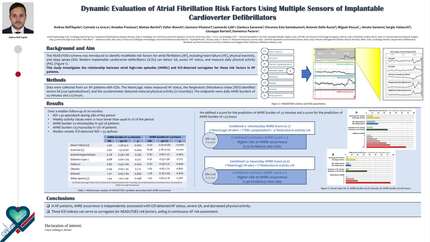
The HEAD2TOES schema was introduced to identify modifiable risk factors for atrial fibrillation (AF), including heart failure (HF), physical inactivity, and sleep apnea (SA). Modern implantable cardioverter-defibrillators (ICDs) can detect SA, assess HF status, and measure daily physical activity (PA). This study investigates the relationship between atrial high-rate episodes (AHREs) and ICD-detected surrogates for these risk factors in HF patients.
To investigates the relationship between AHREs and ICD-detected surrogates for AF modifiable risk factors in HF patients.
Data were collected from 411 HF patients with ICDs. The HeartLogic Index measured HF status, the Respiratory Disturbance Index (RDI) identified severe SA (≥30 episodes/hour), and the accelerometer detected reduced physical activity (≥1 hour/day). The endpoints were daily AHRE burdens of ≥5 minutes and ≥23 hours.
Over a median follow-up of 26 months, the time IN-alert HF state was 13% of the total observation period, RDI ≥30 episodes/h occurred during 58% of the period, and 2% of weekly activity values were ≥1 hour lower than usual. AHRE burden ≥5 minutes/day occurred in 139 (34%) patients and ≥23 hours/day in 68 (17%). Both the IN-alert state and reduced activity were independently associated with AHRE burden (≥5 minutes/day and ≥23 hours/day), while RDI ≥30 episodes/h was associated only with AHRE ≥5 minutes/day. We defined a score for the prediction of AHRE burden of ≥5 minutes as (2*HeartLogic IN-alert + 1*RDI ≥30episodes/hour + 4*Reduction in activity ≥1 hour), and a score for the prediction of AHRE burden of ≥23 hours as (1*HeartLogic IN-alert + 2*Reduction in activity ≥1 hour). Lower score levels (AHRE-5min <4 and AHRE-23hours <2) comprised the largest proportion of follow-up duration (98%), with higher scores linked to higher incidence rate ratios for AHRE (6.75 [95%CI: 1.88-20.16] and 11.46 [95%CI: 3.34-31.72], respectively).
In HF patients, AHRE occurrence is independently associated with ICD-detected HF status, severe SA, and decreased physical activity. These ICD indexes can serve as surrogates for HEAD2TOES risk factors, aiding in continuous AF risk assessment. Event rates - AHRE burden of ≥5 minutes Event rates - AHRE burden of ≥23 hours
Contributors

A Dell'aquila
Author
C La Greca
Author
A Prezioso
Author
M Bertini
Author
V Bianchi
Author
G Vitulano
Author
L Calo'
Author
G Savarese
Author
V Santobuono
Author
A Dello Russo
Author
M Viscusi
Author
A Santoro
Author
S Valsecchi
Author
G Boriani
Author
D Pecora
Author
You may be interested in