Comparison of pacing induced cardiomyopathy following leadless vs conventional pacemaker implantation
EP Europace Journal


Abstract
Leadless pacemaker (LP) has recently gained popularity due to its ease of implantation and absence of lead-related complications. However, limited data exists comparing the risk of pacing-induced cardiomyopathy (PiCM) between LP and conventional transvenous pacemakers (TVP). Given its septum-oriented implantation site, LP may theoretically reduce PiCM occurrence compared to TVP.
This study aimed to evaluate the comparative risk of PiCM between LP and TVP
This retrospective cohort study evaluated 348 patients (130 LP, 218 TVP) for PiCM occurrence. PiCM was defined as new-onset left ventricular (LV) systolic dysfunction (LV ejection fraction < 50% on follow-up echocardiography) with a ≥ 10% decrease in LV ejection fraction from baseline, in the absence of other identifiable causes of LV dysfunction. Primary outcome was PiCM incidence. Secondary outcomes included heart failure hospitalization and all-cause mortality.
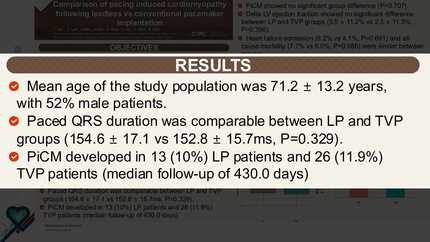
Mean age of the study population was 71.2 ± 13.2 years, with 52% male patients. Baseline characteristics and echocardiographic parameters showed no significant differences between groups. Paced QRS duration was comparable between LP and TVP groups (154.6 ± 17.1 vs 152.8 ± 15.7ms, P=0.329). PiCM developed in 13 (10%) LP patients and 26 (11.9%) TVP patients after a median follow-up of 430.0 days (interquartile range: 254.0-499.0 days) and showed no significant group difference (P=0.707). Delta LV ejection fraction showed no significant difference between LP and TVP groups (3.5 ± 11.2% vs 2.5 ± 11.3%, P=0.396). Secondary outcomes including heart failure admissions (6.2% vs 4.1%, P=0.691) and all-cause mortality (7.7% vs 6.0%, P=0.685) were similar between groups.
Despite theoretical advantages of septal pacing, LP demonstrated similar PiCM risk compared to TVP. These findings suggest that pacemaker type may not significantly influence the development of PiCM. Larger prospective studies with longer follow-up periods are needed to confirm these results and evaluate long-term outcomes.

You may be interested in