The new screw-in fixation single chamber leadless pacemaker: a change of paradigm in the light of the initial real-world experience
EP Europace Journal


Abstract
Leadless pacemaker (LPM) has become a well-established alternative to transvenous pacemaker in the management of bradyarrhythmia offering significant improvements with regards to pacing modes. Since June 2023, the new screw-in fixation LPM (Aveir-VR, Abbott Inc.) has been available on the European market. Additionally to its hardware design, this device differs from the more widespread tine-based LPM (Micra, Medtronic Inc.) also for its recent option of dual chamber upgrading with DDD/R pacing mode. At present, reported experiences with the Aveir-VR are limited due to its recent market introduction.
We present the initial short-term real-world results of the Aveir-VR LPM implantation, in comparison with the Micra-VR and Micra-AV LPM during the same time period.
Between June 2023 and September 2024, consecutive patients implanted with an Aveir-VR, a Micra-VR, or a Micra-AV LPM in three Italian hospitals were retrospective included in the analysis. Indication for an LPM, implant features, safety, and electrical performance were investigated at time of implant and during short-term follow-up (FU).
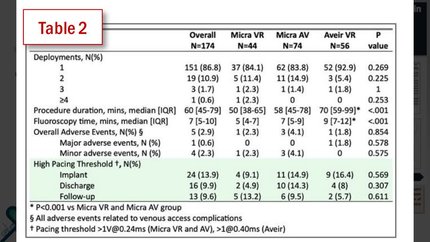
In a total population of 174 LPM patients, 44 patients (25%) received a Micra-VR, 74 (42%) a Micra-AV, and 56 (33%) an Aveir-VR. Baseline characteristics were similar across the three groups (Table 1). Longer procedure and fluoroscopy times were associated to Aveir-VR implantation as compared with Micra-VR and Micra-AV (Table 2). Among patients not requiring atrioventricular (AV) synchrony/atrial pacing (e.g. atrial fibrillation with slow ventricular rate), the implantation rate of the Aveir-VR was significantly lower in comparison to the Micra-VR (19.6% vs. 79.5%, p<0.001). The Aveir-VR was preferred over the Micra-AV in patients with sinus node disease (28.6% vs 10.8%, p=0.027), while implantation rates of the two devices were similar in patients implanted for paroxysmal AV block (Aveir-VR 26.8% vs. Micra-AV 41.9%, p=0.177) (Figure). Micra device was mostly preferred due to concerns about higher infection risk and vascular access, while physician preference was the predominant reason leading to Aveir-VR implantation (Figure). The rate of adverse events and patients with high pacing thresholds were comparable between groups at implantation and after 52 [36-77] days FU.
In the real-world setting, initial experience with the Aveir-VR showed a significant implantation rate (42%) among LPM patients. Although VVI pacing mode was the only option available until June 2024, the Aveir-VR was perceived as an attractive choice particularly in the light of the anticipated dual chamber upgrade, thus driving a considerable implantation rate even at the cost of a temporary inappropriate VVI stimulation. Figure
Contributors

G Mitacchione
Author
A Nicolai
Author
P Fornaro
Author
P Ponchia
Author
P Vinciguerra
Author
G Arabia
Author
M Denora
Author
E Calvi
Author
M Moretti
Author
R Arosio
Author
G Fonte
Author
M Cerini
Author
L Bontempi
Author
G Forleo
Author
A Curnis
Author
You may be interested in