Systematic review of the outcomes and complications of the leadless pacemaker placement based on the national level data
EP Europace Journal


Abstract
Leadless pacemakers have emerged as an innovative solution for managing cardiac arrhythmias, providing an alternative to traditional transvenous pacemakers.
This review aims to conduct a systematic review of the current literature on the use of leadless pacemakers for treating cardiac arrhythmias, focusing on their safety and patient outcomes based on national-level data analysis.
An extensive search of PubMed, Scopus, ScienceDirect, and Google Scholar was conducted by two independent researchers using the keywords "outcomes" OR "complications" AND "leadless pacemaker" following Preferred Reporting Items for Systematic Reviews and Meta-Analyses guidelines. Studies were included if they provided clinical data on the safety and patient outcomes of leadless pacemaker placements at the national level in four categories: short-term complications (perioperative and immediate post-implantation up to 30 days after placement), long-term complications (beyond 30 days), chronic complications (beyond 12 months), and readmission and mortality data.
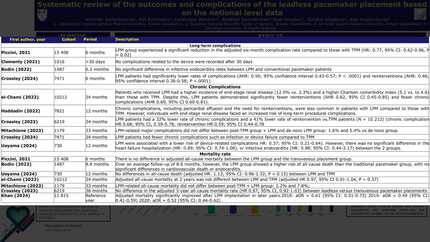
The review includes findings from 15 articles (Figure 1). Perioperative complication rates ranged from 5% to 8.6%, with infection rates as low as 0.2%. Among the four studies that reported long-term complications, one study found no significant difference in the rates of infective endocarditis. Three studies reported a significant reduction in complication rates at six months. Chronic complications were consistently lower in the leadless pacemaker groups. All-cause readmission rates at 30 days ranged from 16% to 17.9%. Mortality rates fluctuated based on follow-up duration: in-hospital mortality was around 4.2%, while mortality beyond 30 days ranged between 5% and 6%. One long-term study reported higher all-cause mortality, but five other studies found no significant difference in adjusted long-term mortality rates between leadless and transvenous pacemakers.
Overall, leadless pacemakers represent a promising technology with a safer profile regarding short-term, long-term and chronic complications compared to traditional pacemakers. However, no difference in long-term mortality was observed according to national-level data from five studies. Future advancements in technology may broaden their applicability.
Contributors

A Sarsenbayeva
Author
A Baimbetov
Author
K Bizhanov
Author
B Baimakhanov
Author
K Abzaliev
Author
S Abzalieva
Author
A Puodziukynas
Author
You may be interested in