Conduction system pacing: how to reduce procedural failures utilizing different sheaths
EP Europace Journal


Abstract
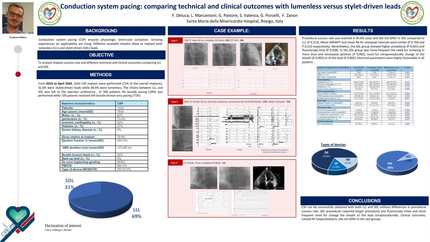
Conduction system pacing (CSP) ensures physiological ventricular activation and avoids the dyssynchrony associated with traditional myocardial pacing. New tools (sheaths and leads) can now better assist the implant thus increasing procedural successes.
Retrospective analysis of CSP implants from January 2019 to April 2024, analyzing procedural success and failures based on tools utilized.
From January 2019 to April 2024, 1033 CSP implant were performed, being 72% of the overall implants (excluding single and dual chamber ICDs). 89% were PMs and 11% were ICDs. 31.6% were styled driven leads while 68.4% were lumenless leads. Pacing indications were standard with prevalence of AV block (50%); AF with slow ventricular rate 12%; sinus node disease 12%; ablate&pace 9%; heart failure or cardiomyopathy 14%, re-interventions after malfunction of a previous implant 1%. Mean age was 78±8 years; 62% were males.
CSP was successfully achieved in 95.2% of cases considering all indications. In 4.8% of cases, CSP lead implant failed and the lead was then implanted in the RV septum or coronary sinus. Reasons for failure were: 2.7% due to suboptimal electrical parameters (mainly high threshold); 1.1% uncorrected BBB; 0.9% intraprocedural lead dislodgement; 1.4% impossibility to penetrate the septum; 1.4 % severe right atrial enlargement. Heart failure and left ventricular dysfunction (EF<45%) were found more frequently in the failed implant subgroup. Procedural failures were more frequently associated with intraprocedural need for changing the sheath (utilizing a different curve) or changing the lead. Interestingly, in 13.4 % of cases the intraprocedural sheath’s change allowed to successfully complete the procedure; and in the 5.4% of cases the intraprocedural lead’s change (i.e. shifting from lumenless to styled-driven or viceversa) turned a failure into a success. No predictors of procedural failure were found in the logistic regression analysis. Failed implants have not decreased over the years, likely being related to increasingly complex cardiac conditions where CSP has been attempted.
conduction system pacing is feasible in daily clinical practice. Both lumenless and stylet-driven lead can be utilized. Different sheaths allow to customize the procedure based on the anatomy. During a 5-year experience, the overall procedural success rate was 95.2% while 4.8% of the procedures failed. Intraprocedural sheath’s change turned 13.4% of initial failure into successes while intraprocedural lead’s change turned 5.4% of initial failure into successes. Interestingly the failure rate has not decreased over the years.
Contributors

F Deluca
Author
L Marcantoni
Author
G Pastore
Author
S Valenza
Author
G Porcelli
Author
F Zanon
Author
You may be interested in