Long-term mechanical synchrony in left bundle branch area pacing
EP Europace Journal


Abstract
Left bundle branch area pacing (LBBAP) has shown significant benefits, particularly through enhanced electromechanical synchrony in the left ventricle. However, its long-term mechanical effects are still not fully understood.
To assess the long-term mechanical synchrony in patients with LBBAP, using myocardial work (MW) and other echocardiographic parameters.
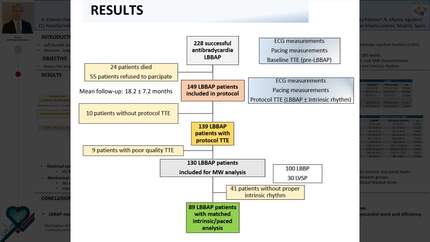
Patients with successful LBBAP for bradycardia pacing and preserved left ventricular ejection fraction (LVEF) were consecutively enrolled. Mechanical synchrony was assessed during follow-up using 2D echocardiographic variables, myocardial strain, and MW measurements. Two echocardiograms were performed with a minimum interval of 30 minutes: one during paced rhythm and, if feasible, another during spontaneous rhythm. LBBAP was assessed based on current criteria.
The study included 149 patients: 114 with left bundle branch pacing (LBBP) and 35 with left ventricular septal pacing (LVSP), with a mean follow-up of 18.2 ± 7.2 months. V6 R-wave peak time, interpeak interval, and QRS duration showed significant reductions from implant (77.8±11.8 ms vs. 74.8±11.9 ms, p=0.001; 40.6±13.2 ms vs. 38.5±12.4 ms, p=0.044; and 115.7±12.9 ms vs. 109.3±13.2 ms, p<0.001, respectively) (Table 1). The mean pre-implant LVEF was 61.6±4.9%, while follow-up non-paced LVEF was 57.3±5.7% (p<0.001). There was no significant difference between paced LVEF (57.5±4.3%) and non-paced LVEF (57.2±5.6%) at follow-up (p=0.481). Left ventricular end-diastolic and end-systolic volumes were slightly lower during pacing than during non-pacing (70.7±20.7 vs. 74.3±20.5, p=0.003, and 32.5±10.4 vs. 34.3±11.1, p=0.031, respectively). Interventricular mechanical delay (IVMD) did not differ significantly between intrinsic and paced beats (32.4±16.1 vs. 29.4±16.2, p=0.101). Peak strain dispersion (PSD) was slightly reduced during paced beats (62.1±21.2 vs. 69.8±27.5, p=0.013). Global longitudinal strain (GLS) did not differ significantly between intrinsic and paced beats (-14.4±6.8 vs. -14.9±7.0, p=0.071). The global work index (GWI) was similar between groups (1513.3±399.6 vs. 1496.7±400.2, p=0.723). However, paced beats showed higher global constructive work (GCW) (2148.0±434.2 vs. 1993.9±388.2, p<0.001) and global wasted work (GWW) (264.8±136.8 vs. 222.0±138.2, p=0.004), with no significant difference in global work efficiency (GWE) (88.2±4.5 vs. 88.9±5.2, p=0.189). These trends were consistent across patients with both narrow and wide baseline QRS (Table 2).
Consistent with improvements in electrical synchrony, mechanical synchrony parameters showed positive long-term outcomes. LBBAP-mediated beats demonstrated performance comparable to intrinsic beats in terms of ventricular volumes, LVEF, and advanced parameters of myocardial work and efficiency. Electrical synchrony parameters Mechanical synchrony parameters
Contributors

A Estevez Paniagua
Author
S Briongos Figuero
Author
M Tapia Martinez
Author
S Jimenez Loeches
Author
A Sanchez Hernandez
Author
E Sanchez Lopez
Author
A Luna Cabadas
Author
D Heredero Palomo
Author
R Munoz Aguilera
Author
You may be interested in