Safety and effectiveness of adapted definitive pacemakers to perform temporary cardiac stimulation - The TEMPACE multicenter study
EP Europace Journal


Abstract
Temporary Cardiac Pacing (TCP) is commonly used not only in urgent cases but also in elective procedures, providing essential support during interventional cardiology. Non-fixation systems are linked to a high rate of complications, whereas definitive pacemakers, used off-label as temporary devices, show better clinical outcomes. The lack of certified devices for TCP poses risks to patients.
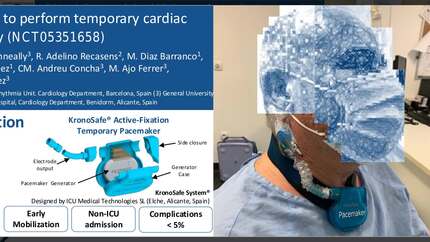
To evaluate the safety and efficacy of TCP using active fixation leads and a novel holding system. (Picture 1)
This was a multicenter clinical study of a medical device approved by the Clinical Research Ethics Committee and the Spanish Regulatory Agency. Patients requiring temporary cardiac pacing for more than 48 hours, from January 2023 to October 2024, were included. A 58-60 cm active fixation lead was implanted under ultrasound guidance via the left or right internal jugular vein, anchored in the right ventricle. In the end, all the parts of the pacemaker were held in place by a specifically designed holdyng system. Effectiveness measures, including electrode impedance, R-wave sensing, and pacing thresholds, were collected every other day. Complications like capture or sensing failure, electrode displacement or fracture, generator detachment, and cardiac perforation were monitored daily. Additional data included pacing hours in the Intensive Care / Acute Cardiology Unit and the general ward.
A total of 29 patients from two centers were included: 9 with transcatheter aortic valve implantation, 9 with complete atrioventricular block, 5 with septal alcohol ablation, 2 with bradycardia-tachycardia syndrome, 2 with slow atrial fibrillation, 1 with device infection, and 1 with myocarditis. All R-wave amplitudes, impedance values, and pacing thresholds remained within normal limits (Picture 2), except for one case of electrode displacement due to patient agitation on day 25, with no clinical consequences. The mean pacing duration was 7.5 days, with 79.4% of pacing time spent in the ward without mobility restrictions.
Temporary cardiac pacing with active fixation leads is effective and safe, allowing patient management in general hospital wards.
Agitation and disorientation may increase the risk of complications.
A holding system that adapts definitive pacemakers provides the necessary safety for temporary pacing Temporary pacemaker holding system Electrical pacemaker parameters
Contributors

R Vicente Miralles
Author
J L Anton Pascual
Author
N Rivas Gandara
Author
A Ibanez Criado
Author
L Fuertes Kenneally
Author
R Adelino Recasens
Author
M Diaz Barranco
Author
P Jordan Marchite
Author
A Garcia Fernandez
Author
M A Carmona Ramirez
Author
F A Jaime Sanchez
Author
C M Andreu Concha
Author
M Ajo Ferrer
Author
V Bertomeu Gonzalez
Author
J G Martinez Martinez
Author
You may be interested in