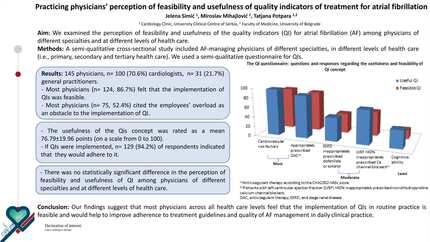
Practicing physicians perception of feasibility and usefulness of quality indicators of treatment for atrial fibrillation
EP Europace Journal


Abstract
The concept of considering quality indicators (QI) of the management of various health conditions has been increasingly used to improve the implementation of evidence-based medicine and quality of treatment in practice. The European Society of Cardiology proposed a list of QIs for atrial fibrillation (AF) management as the tools for measurement and improvement of the quality of AF care in practice. In the present study we examined the perception of feasibility and usefulness of the Qis for AF among physicians of different specialties and at different levels of health care.
A semi-qualitative cross-sectional study included AF-managing physicians of different specialties, in different levels of health care (i.e., primary, secondary and tertiary health care). The semi-qualitative questionnaire for QIs with 20 questions (and answers) is shown in Figures 1 and 2.
Of 145 physicians (51.0% female), n= 100 (70.6%) were cardiologists, and n= 31 (21.7%) were general practitioners. Most physicians (n= 124, 86.7%) felt that the implementation of QIs in their practice was feasible. As an obstacle to the implementation of QI, most physicians (n= 75, 52.4%) cited the employees’ overload. The most useful QI, as reported by the respondents, was the identification and correction of cardiovascular risk factors (n= 132, 96.4%), while the least useful QI was the assessment of cognitive ability (n= 50, 36.5%). The assessment of adequacy of anticoagulant therapy prescription according to the CHA2DS2-VASc score was considered feasible by n= 114 of participants (82.6%), while the lowest feasibility of implementation was attributed to the assessment of cognitive ability (n= 25, 18.2%). On scale from 0 to 100, the usefulness of the Qis concept in clinical practice was rated as a mean 76.79±19.96 points, and n= 129 (94.2%) of respondents indicated that if QIs were implemented, they would adhere to it.
Our findings suggest that most physicians feel that the implementation of QIs in routine practice is feasible and would help to improve adherence to treatment guidelines and quality of AF management in daily clinical practice. The QI questionnaire: questions and re The QI questionnaire: questions and resp
Contributors

You may be interested in