Sudden cardiac death in patients with atrial fibrillation: role of heart failure, coronary artery disease and biomarkers - Insights from the ARISTOTLE trial
EP Europace Journal


Abstract
Atrial fibrillation (AF) has been suggested as a risk factor for ventricular arrhythmias and sudden cardiac death (SCD). Both heart failure (HF) and coronary artery disease (CAD) are common comorbidities in AF and may influence the risk of SCD.
This study aimed to investigate the incidence of SCD in patients with AF with and without HF or CAD (defined as documented CAD, prior myocardial infarction, and/or history of coronary revascularization), as well as to identify clinical characteristics and biomarkers that are risk indicators for SCD in patients with AF.
The ARISTOTLE trial randomized 18,203 patients with AF to either apixaban or warfarin. Left ventricular ejection fraction (LVEF) was available in 12,914. Biomarker levels (NT-proBNP, hs-troponin T, IL-6, GDF-15 and cystatin C) were measured in baseline plasma samples in 14,954 patients. Kaplan-Meier curves and unadjusted Cox proportional hazards models were used to assess associations between covariates and SCD. Causes of death were centrally adjudicated.
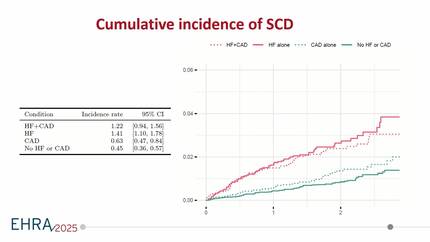
During median follow-up of 1.8 years a total of 1,272 patients died, 255 (20%) due to SCD. Male sex, a history of CAD, left ventricular dysfunction, and left bundle branch block were more common among patients with SCD compared with the overall population. Baseline biomarker levels were higher among patients with SCD, particularly the cardiac biomarkers NT-proBNP (75% higher) and hs-troponin T (56% higher), and the inflammatory biomarker IL-6 (52% higher), compared with the overall study population. The annual incidence rate of SCD was 0.45 in patients without concomitant HF or CAD versus 1.41 in patients with concomitant HF, representing a 3-fold increase in the risk of SCD associated with the presence of HF (Figure 1). The incidence of SCD in patients with CAD alone was 0.63, suggesting that CAD alone is not significantly associated with a higher SCD risk (Figure 1). The strongest predictors of SCD were NT−proBNP, hs−cTnT, LVEF, IL−6, and GDF−15 (Figure 2: univariable hazard ratios (HR) sorted by p-value, for continues variables calculated between the first and third quartiles).
In an AF population, the SCD risk is low in absence of HF. CAD alone does not seem to contribute substantially to the risk of SCD among patients with AF. Biomarkers of cardiac function and inflammatory/oxidative stress were, along with LVEF, the variables most strongly associated with SCD risk in patients with AF. Cumulative incidence of SCD
Contributors

B Kommata
Author
E Frank
Author
J Lindback
Author
J H Alexander
Author
C B Granger
Author
S M Al-Khatib
Author
R D Lopes
Author
J Oldgren
Author
A Siegbahn
Author
L Wallentin
Author
Z Hijazi
Author
You may be interested in