Left atrial appendage morphology and dynamic parameters differ between patients with and without atrial fibrillation
EP Europace Journal


Abstract
Patients with atrial fibrillation (AF) are at increased risk of stroke, often arising from a thrombus in the left atrial appendage (LAA). In selected cases, left atrial appendage occlusion or closure is an alternative for stroke prevention with oral anticoagulation. To assess the risk of stroke and the benefit of LAA closure and to select the appropriate device, it is crucial to quantify the morphology and dynamics of the left atrial appendage (LAA). To date, much about LAA dynamics in this setting is unknown, and subsequently the risk of embolic stroke and inappropriate device positioning is insufficiently explored.
We describe the morphological and dynamic differences of the left atrium (LA) and LAA in high risk AF patients compared to controls undergoing trans catheter aortic valve implantation (TAVI).
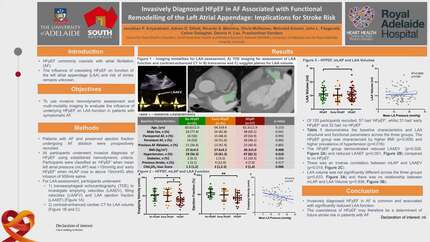
Our study population consists of 14 patients, seven with AF and seven without AF, undergoing TAVI, since dynamic computed tomography (CT) angiography scans are performed in the standard of care in these patients. The scans were acquired every 5% of the cardiac cycle (i.e., R-R interval on the ECG) (Figure 1a). The LA and LAA were semi-automatically segmented (Figure 1b) to determine the following parameters across the entire cardiac cycle: LA volume; LAA volume, depth, height, and length; and ostium area, eccentricity, and diameter.
AF patients had a significantly larger LA volume (108 mL vs 68 mL, p=0.03), while the LA volume change throughout the cardiac cycle was similar in AF patients and controls. Both groups had an LA volume change of 35mL on average. Figure 1cd shows the LA and LAA volume curves of a patient with and without AF. The LAA ostium size and volume of AF patients exhibited larger dynamic variations than those from non-AF patients, while the ostium eccentricity in AF patients showed less variation and the ostium shape was rounder.
We found differences in morphologic and dynamic parameters of the LA and LAA between AF and non-AF patients. The morphology and dynamics of the LAA can increase the understanding of LAA thrombus formation. Moreover, it may have implications for the risk of embolic stroke and may assist in the selection of the optimal LAA closure device type and size.
Contributors

I Meijer
Author
I Van Der Snoek Fidalgo
Author
M Saiz-Vivo
Author
C Albors
Author
J Baan
Author
M M Vis
Author
O Camara
Author
R N Planken
Author
J R De Groot
Author
H A Marquering
Author
N Arrarte Terreros
Author
You may be interested in