Three-year safety and effectiveness of Hybrid Ablation versus Catheter Ablation: Final results of the CEASE-AF trial
EP Europace Journal


Abstract
The prospective, multi-center, randomized CEASE-AF trial previously reported that hybrid ablation with left atrial appendage exclusion (LAAE) improved freedom from atrial arrhythmias by 32% and 33% through 12- and 24-months compared to endocardial catheter ablation in patients with non-paroxysmal atrial fibrillation (AF). In this analysis, we report 3-year outcomes of CEASE-AF.
To evaluate long-term safety and effectiveness of de novo hybrid ablation with LAAE compared to endocardial catheter ablation for non-paroxysmal AF
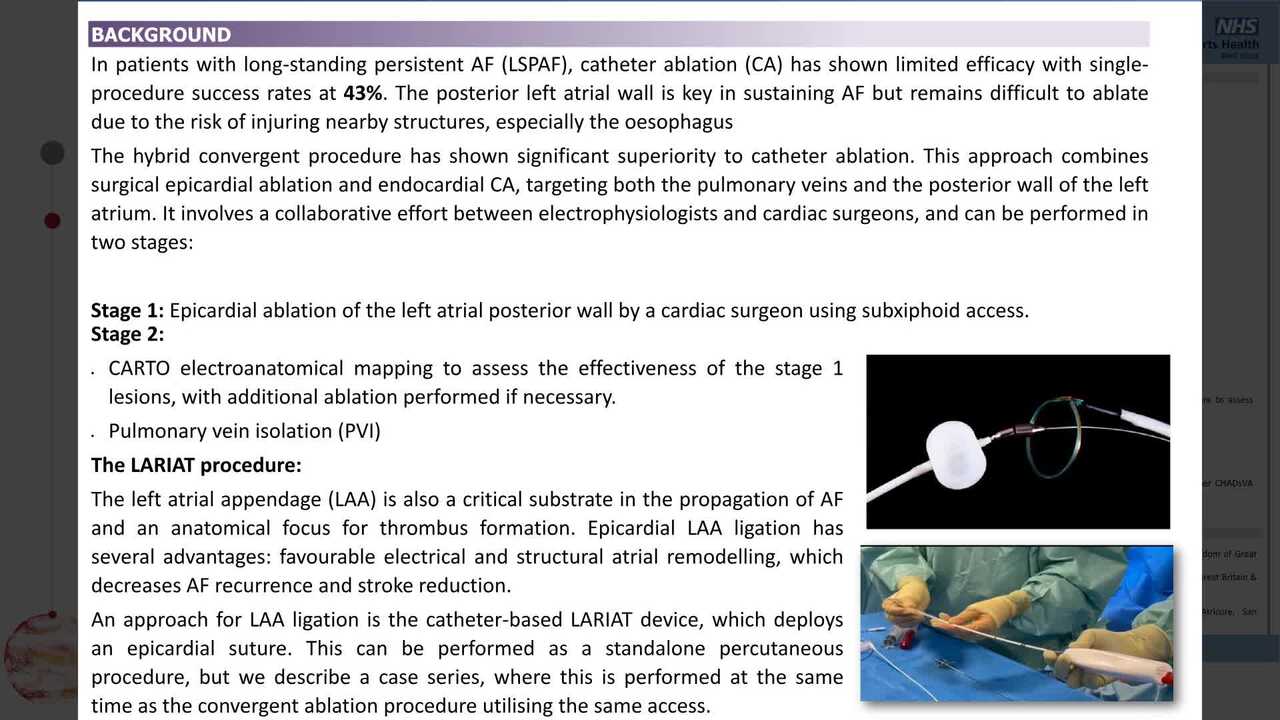
Patients 18-75 years of age with no prior ablation who had symptomatic, drug-refractory persistent AF and enlarged left atrium (>4 cm) or longstanding persistent AF (LSPAF) were eligible. Patients were randomized 2:1 to a) staged epicardial-endocardial (hybrid) ablation to achieve left atrial posterior wall (LAPW) and pulmonary vein isolation (PVI) as well as LAAE or b) endocardial catheter ablation, including repeat ablation with 180 days of the index procedure, to achieve PVI. Effectiveness was freedom from AF, atrial flutter (AFL), or atrial tachycardia (AT) off anti-arrhythmic drugs (AADs) except previously failed AADs at same or lower dose. Rhythm was assessed by 48-hr Holter and adjudicated by an independent core laboratory. The safety endpoint was major complication rate adjudicated by an independent clinical events committee. Reinterventions could include repeat ablations (including epicardial crossover), electrical or pharmaceutical cardioversion, implantation of a permanent pacemaker or implantable cardioverter defibrillator, or other interventions.
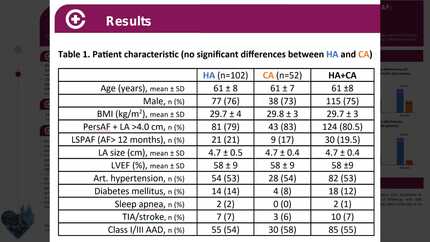
102 patients were in the Hybrid Arm and 52 in the Catheter Arm, with similar baseline characteristics. Mean age was 60.7±7.9 years, mean LAD was 4.7±0.4 cm, 74% were male, and 19% had LSPAF. Through 36-months, effectiveness was 61.1% (58/95) in the Hybrid Arm and 27.5% (14/51) in the Catheter Arm (p<0.001), an absolute difference of 33.6% (95% CI: 15.9%-48.5%). In patients with persistent AF, effectiveness was 61.0% (47/77) in the Hybrid Arm and 32.6% (14/43) in the Catheter Arm (p=0.003). In patients with LSPAF, effectiveness was 61.1% (11/18) in the Hybrid Arm and 0% (0/8) in the Catheter Arm (p=0.007). Through 36-mo, safety rates were 12.7% (13/102) and 9.6% (5/52) in the Hybrid and Catheter Arms, respectively (p=0.79). Safety and effectiveness across the trial duration are shown in the Figures. In the Hybrid Arm, 28.4% (27/95) of patients had a reintervention through 36-mo, compared to 56.9% (29/51) in the Catheter Arm (p<0.001).
In CEASE-AF, the rhythm control benefit of a hybrid ablation approach exceeded that of an endocardial-only approach for non-paroxysmal AF, and this effect was durable through 36-months without significantly increasing complications. Efficacy Complications
Contributors

N Doll
Author
T Weimar
Author
P Suwalski
Author
G Moennig
Author
D A Kosior
Author
M Wijffels
Author
B Van Putte
Author
A Bulava
Author
A Mokracek
Author
N Rueb
Author
P Nemec
Author
T Ostrizek
Author
E Fransen
Author
S Hunter
Author
J Sahu
Author
You may be interested in