Anticoagulation guided by long-term ECG monitoring in patients who remain free of atrial fibrillation for the first year following pulmonary vein isolation
EP Europace Journal


Abstract
Following pulmonary vein isolation (PVI), there are patients who remain free of atrial fibrillation (AF). Current clinical guidelines recommend continued oral anticoagulation (OAC) in patients (pts) at high risk of stroke, irrespective of ablation outcome. These guidelines do not account for our ability to objectively monitor pts long-term for AF recurrence. There are scarce data about use of OAC guided by data from long-term ECG monitoring.
To determine long term outcomes in post-PVI AF pts in whom use of OAC was guided by ECG data from an implantable loop recorder (ILR).
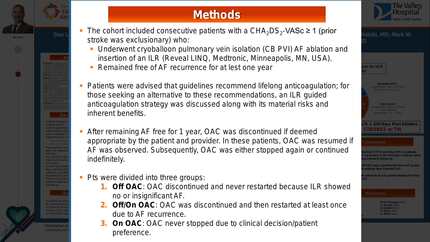
We enrolled consecutive pts with AF, CHA2DS2-VASc ≥ 1 in men and ≥ 2 in women, who remained AF-free (as confirmed by an ILR) for the first-year post cryoballoon (CB) PVI and. ECG data from the ILR were adjudicated daily. After one-year post-ablation, further use of OAC in AF-free patients was based on patient preference.
219 consecutive pts underwent CB PVI; of these, 125 (57%) pts (67 ± 9 years, 68% male, CHA2DS2-VASc 2.5 ± 1.2) remained AF-free for the first-year post CB PVI. 85 (68%) of these pts chose to discontinue OAC and pursue an ILR guided OAC strategy. During a follow-up of 1176 ± 639 days, 62 (73%) pts continued to remain free of AF and 7 (8%) pts had only short and rare episodes of AF; these pts remained off OAC (Figure). The other 16 (19%) pts resumed OAC due to AF recurrence. Only 1 patient had a TIA/stroke; this occurred in a patient on OAC.
Our data show that following CB PVI more than 80% of pts who did not have an AF recurrence in the first year could be safely managed off OAC during long-term follow-up. These data may provide rationale an ILR guided strategy for long-term use of OAC post PVI.
Contributors

S Kochav
Author
A Bhatt
Author
M Habibi
Author
M Preminger
Author
T Sichrovski
Author
A Musat
Author
D Musat
Author
R Shaw
Author
S Mittal
Author
N Milstein
Author
L S Park
Author
You may be interested in