Impact of genetic variants on ablation outcomes and left ventricular function in left ventricular cardiomyopathy patients undergoing catheter ablation for atrial arrhythmias
EP Europace Journal


Abstract
Atrial arrhythmias (AAs) in patients with left ventricular cardiomyopathy (LV-CM) are frequent and manifest at a younger age than in the general population. Different (likely) pathogenic variants (LP/PVs) in cardiomyopathy related genes are associated with variable penetrance, disease expression and progression which may be relevant for AA substrates. Data on AA ablation outcomes in patients with an LV-CM phenotype are sparse and data on genotype-specific ablation outcomes in this cohort are currently lacking. The aim of this study was to analyze outcomes of CA in LV-CM patients in relation to different genotypes.
Patients who underwent CA for non-CTI dependent AAs and genetic testing for pathogenic variants in CM-associated genes (n=72, 96% with structural LV abnormalities; n=3, 4% tested during family screening) were included. Genetic testing results, ablation outcomes (one year AA-free survival) and clinical outcomes (echocardiography parameters at one year follow up) were analyzed across subgroups based on genetic findings (LP/PV-negative, TTN, LMNA, and other LP/PV).
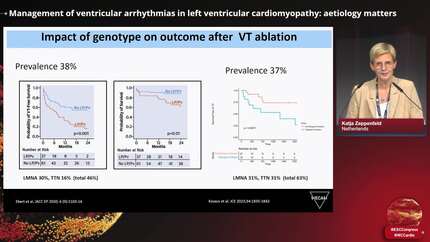
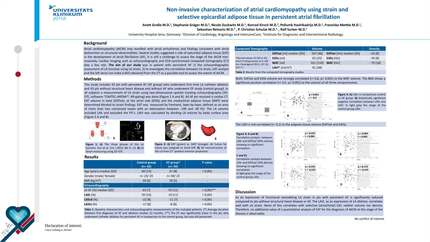
Seventy-five consecutive patients (age 58 ± 13 years, 76% male, mean LV-EF 45.8% ± 11%) who underwent CA for AAs were included (paroxysmal AF: n=24, 32%; persistent AF: n=40, 53%; AF only: n=46, 61%; AF + atypical flutter: n=8, 11%; atypical flutter only: n=11, 15%). A LP/PV was found in 28 (37%) patients (LMNA: n=13/28, 46%; TTN: n=10/28, 36%; Other LP/PV: n=5/28, 18%) (Figure 1). One-year AA-free survival did not differ between patients with and without LP/PV [LP/PV-: 65%, 95% CI (51% to 80%) vs. LP/PV+: 60%, 95% CI (41% to 78%), Log Rank=0.365] (Figure 2A). In a subgroup analysis, LMNA patients had a higher chance of 1-year AA recurrence compared to LP/PV- [HR=3.081, 95% CI (1.296-7.325)] while patients with a TTN LP/PV did not [HR=0.899, 95% CI (0.26-3.106)] (Figure 2B). In a univariable analysis, an LMNA LP/PV, AV block at baseline, LA/RA low-voltage areas were predictors of AA recurrence (p<0.1). In a multivariable analysis, an LMNA LP/PV was the only independent predictor [HR: 3.835, 95% CI (1.296-11.351), p=0.015]. At 1 year FU, left ventricular ejection fraction (LV-EF) significantly improved in TTN patients (BL 44% ± 9.2 vs. FU 48.8% ± 8.5, p=0.022), while no significant changes were observed for the other subgroups (LP/PV-: BL 45.4% ± 10.5 vs. FU 48.5% ± 8.7, p=0.063; LMNA: BL 52% ± 9.2 vs. FU 50% ± 11.8, p=0.296; Other LP/PV: BL 37.1% ± 8.4 vs. FU 39.3% ± 7.9, p=0.161).
In LV-CM patients undergoing CA for AAs, LMNA LP/PVs were associated with higher recurrence rates post-ablation. In contrast, patients with TTN LP/PVs did not have a higher recurrence rate than patients without LP/PVs and, importantly, they showed improvement in LV function after ablation. These findings may inform patient selection and support the development of genotype-tailored treatment strategies.
Contributors

S Dittrich
Author
M De Riva
Author
N Elmasry
Author
S Trines
Author
S Piers
Author
R Alizadeh Dehnavi
Author
M Bootsma
Author
D Barge-Schaapveld
Author
K Zeppenfeld
Author
A P Wijnmaalen
Author
You may be interested in