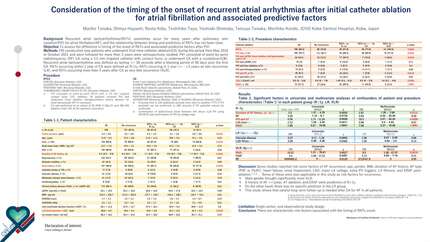
Consideration of the timing of the onset of recurrent atrial arrhythmias after initial catheter ablation for atrial fibrillation and associated predictive factors
EP Europace Journal


Abstract
Recurrent atrial tachyarrhythmias(RATs) sometimes occur for many years after pulmonary vein isolation(PVI) for atrial fibrillation(AF), and the relationship between timing and predictors of RATs has not been clear.
To assess the difference in timing of the onset of RATs and associated predictive factors after PVI.
230 consecutive new patients who underwent first-time catheter ablation(CA) during the period from May 2018 to October 2021 and were followed for more than 3 years were retrospectively studied. PVI consisted of point-by-point radiofrequency(RF) CA using a 3.5 mm irrigated catheter with contact force, or underwent CA with a cryoballoon(CB). Left atrial posterior wall isolation(LAPWI), linear ablation, defragmentation, ablation of atrial tachycardia (AT), and/or supra vena cava isolation(SVCI) were performed with RF. The primary endpoint was RATs lasting >= 30 seconds 90 days after the first CA, and RATs occurring within 1 year of CA were defined as R<1y, RATs occurring in 1 year <= - <3 years as late recurrence(LR), and RATs occurring more than 3 years after CA as very late recurrence(VLR).
Mean age was 71.9 years old, 134 were men, and mean follow-up term was 4.3years. 130 patients (56.5%) had paroxysmal AF(PAF), and total 99 patients (43.0%) had RATs. The number of patients who developed RATS was as follows: 49 patients had R<1y, 36 had LR, and 14 had VLR. Univariate logistic analysis showed that VLR was significantly more frequent in males (odds ratio(OR)=10.21, p=0.0027), in patients with persistent AF(PeAF) (OR=3.5, p=0.0291), and all patients with VLR underwent CA with RF (p=0.012), and that R<1y was clearly associated with patients with a history of AF of more than 1 year (OR=2.5, p=0.005), CA with RF (OR=3.29, p=0.0144), with AT ablation (OR=4.38, p=0.0028), with low voltage area(LVA) >2cm2 of LA calculated by CARTO3 or EnSite NavX (OR=2.12, p=0.0411) or with early recurrence of atrial fibrillation(ERAF) within 90 days after CA(OR=6.43, p<0.0001). Multivariate logistic analysis showed that male gender was a predictive factor for VLR group(OR=8.51, 95%CI:1.08-67.07, p=0.0076), and that a history of AF of more than 1 year, AT ablation, and ERAF were predictors for R<1y group (OR=2.97, 95%CI: 1.25-7.08, p=0.0122, OR=10.29, 95%CI: 2.51-42.24, p=0.0008, OR=7.89, 95%CI: 3.27-19.06, p=<0.0001). In patients with a left atrial diameter(LAD) of over 42 mm, LR occurred more frequently in univariate logistic analysis(OR=2.06, p=0.0489), but multivariate logistic analysis did not identify any predictors of LR occurrence.
There are characteristic risk factors associated with the timing of RATs onset. Male gender brought significantly more VLR, and a history of AF >=1year, AT ablation, and ERAF were predictors of R<1y. On the other hand, there was no specific predictor in the LR group. This study also shows that careful long-term follow-up is needed after CA for AF in all patients.

You may be interested in