Consideration of Tako-Tsubo syndrome associated with catheter ablation for atrial fibrillation
EP Europace Journal


Abstract
Tako-tsubo syndrome(TTS) is a rarely reported complication of catheter ablation(CA) for atrial fibrillation(AF).
To investigate the risk factors and characteristics of patients who develop TTS after CA for AF.
481 consecutive cases who underwent initial or multiple CA for AF between May 2018 and March 2024 were retrospectively studied. Pulmonary vein isolation(PVI) consisted of point-by-point radiofrequency(RF) CA using a 3.5 mm irrigated catheter with contact force, or using cryoballoon(CB). All ablations except PVI were performed with RF. General anaesthesia by endotracheal intubation or deep sedation with non-invasive positive airway pressure ventilation was used in all cases.
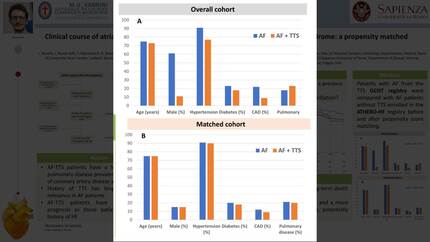
Mean age was 72.5 years old, 211 were female, and mean follow-up term was 2.3 years. 231 cases were treated for paroxysmal AF(PAF), 392 were 1st session and 129 were treated by CB. Three patients had TTS as complication of CA. Case 1 was a 76-year-old female who had her 1st session of RFCA for PAF. She had diabetes mellitus(DM). The echocardiogram before the CA showed left ventricular ejection fraction(LVEF) was 65.2% and left atrial diameter(LAD) was 46.4 mm. She received PVI, LA AT ablation, cavotricuspid isthmus(CTI) ablation, and the administration of isoproterenol(ISP) for arrhythmia induction. Her TTS appeared the day after CA. Case 2 was an 84-year-old female undergoing 2nd session of RFCA for persistent atrial fibrillation(PeAF). She had hypertension, heart failure(HF), and chronic kidney disease(CKD). LVEF was 65.2 and LAD was 37.4 before CA, and she received LA posterior wall isolation, defragmentation of LA septum and inferior area, ISP, and electrical cardioversion(CV) to treat for induced arrhythmias. Her TTS occurred during CA. Case 3 was a 90 years-old female with 1st session of RFCA for PeAF. She had HF and CKD. LVEF was 57.9, LAD was 45.6 before CA, and she received PVI, roof line ablation, CTI ablation, ISP, and CV. Her TTS appeared the day after CA. In all three cases, cardiac function recovered before discharge. There were some similarities between the three cases: elderly women, ISP, and RFCA. Of these, univariate logistic analysis revealed that age 75 years or older and female were significantly associated with TTS (p=0.0383, p=0.0266). Generally, TTS is more common in older women and is thought to be caused by physical and mental stress. Coronary artery spasm and catecholamine involvement in its pathogenesis have been reported. TTS associated with CA is thought to be caused by denervation of the vagus nerve by ablation of the ganglionated plexi (GP) and subsequent sympathetic nervous tension. In addition, it has been suggested that the administration of ISP during CA may contribute to myocardial stress.
This study suggests that older age and female gender are risk factors for TTS and that ISP administration may also be a risk factor for the development of TTS associated with CA for AF.

You may be interested in