Predictors of recurrence in atrial fibrillation patients undergoing pulmonary vein and posterior wall isolation
EP Europace Journal


Abstract
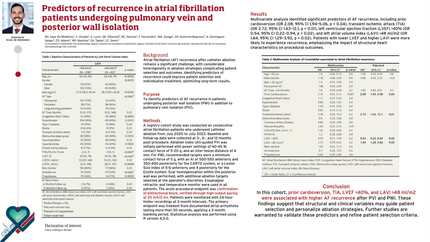
Atrial fibrillation (AF) recurrence after catheter ablation remains a significant challenge, with considerable heterogeneity in ablation strategies complicating patient selection and outcomes. Identifying predictors of recurrence could improve patient selection and individualize treatment, optimizing long-term results.
To identify predictors of AF recurrence in patients undergoing posterior wall isolation (PWI) in addition to pulmonary vein isolation (PVI).
A registry cohort study was conducted on consecutive atrial fibrillation patients who underwent catheter ablation from July 2020 to July 2023. Baseline and follow-up data were collected at 3-, 6-, and 12-months post-procedure. Ablation index (AI)-guided PVI was initially performed with power settings of 40-45 W, contact force of 5-20 g, and an inter-lesion distance of 4 mm. For PWI, recommended targets were a minimum contact force of 5 g, with an AI of 500-550 anteriorly and 350-400 posteriorly for the CARTO system, or a Lesion Size Index of 5-6 anteriorly and 4 posteriorly for the Ensite system. Scar homogenization within the posterior wall was performed, with additional ablation targets selected at the operator's discretion. Esophageal retractor and temperature monitor were used in all patients. The acute procedural endpoint was confirmation of bidirectional block, verified through high-output pacing at 25 mA/2 ms. Patients were monitored with 24-hour Holter recordings at 3-month intervals. The primary endpoint was freedom from documented atrial arrhythmia lasting more than 30 seconds, applying a 3-month blanking period. Statistical analysis was performed using R version 4.3.0.
Multivariate analysis identified significant predictors of AF recurrence, including prior cardioversion (OR 2.08, 95% CI 1.94–5.06, p = 0.04), transient ischemic attack (TIA) (OR 2.72, 95% CI 1.63–12.1, p = 0.01), left ventricular ejection fraction (LVEF) >40% (OR 0.54, 95% CI 0.22–0.94, p = 0.02), and left atrial volume index (LAVI) >48 ml/m² (OR 1.64, 95% CI 1.29–3.92, p = 0.02). Patients with lower LVEF and higher LAVI were more likely to experience recurrence, emphasizing the impact of structural heart characteristics on procedural outcomes.
In this cohort, prior cardioversion, TIA, LVEF <40%, and LAVI >48 ml/m² were associated with higher AF recurrence after PVI and PWI. These findings suggest that structural and clinical variables may guide patient selection and personalize ablation strategies. Further studies are warranted to validate these predictors and refine patient selection criteria. Baseline Cohort Characteristics Multivariate Analysis
Contributors

R H Isaac De Medeiros
Author
S Giraldo
Author
S Luna
Author
D E Villarreal
Author
D E Garnica
Author
F Hernandez
Author
M A Zuniga
Author
D V Gutierrez-Bejarano
Author
A Dominguez-Vargas
Author
C D Adams
Author
W F Bautista
Author
C A Tapias
Author
L C Saenz
Author
You may be interested in