Acute procedural outcomes of pulsed field ablation in elderly patients with atrial fibrillation: sub-analysis of the global FARADISE registry
EP Europace Journal


Abstract
The prevalence of atrial fibrillation (AF) significantly increases with age. Approaches for managing AF in the elderly patient population are limited, and catheter ablation in this population is generally associated with more complications. Pulsed field ablation (PFA) may provide an alternative ablation option given the efficient procedure times and favorable safety profile. The elderly population has unique therapeutic limitations for managing AF with catheter ablation. To date, limited evidence exists on the procedural outcomes of this patient population as they generally are not included or are underrepresented in clinical trials.
Evaluate acute procedural outcomes in elderly patients treated using the pentaspline PFA catheter.
FARADISE is a prospective, global registry that enrolled subjects clinically indicated for an AF ablation procedure using the pentaspline PFA catheter. Procedural characteristics and acute safety and efficacy were collected and compared between patients ≥75 years old versus patients <75 years old. Long-term follow-up is still ongoing.
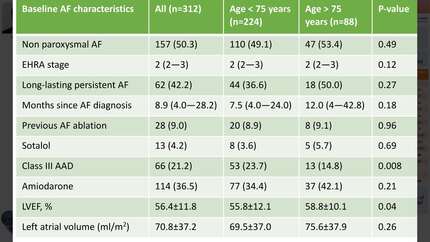
Out of 1173 subjects enrolled in the FARADISE registry, 1160 subjects have complete procedural data. Grouped by age at the time of ablation, 158 (13.6%) subjects were ≥75 years old. The older patients were more frequently female (52.5% vs 30.0%), had higher rates of comorbidities including cardiovascular disease, COPD, and renal disease, and more often diagnosed with persistent AF (42.0% vs 31.2%). Procedure time and fluoroscopy time were similar between groups, respectively (≥75: 58.3 ± 25.0 vs. < 75: 57.3 ± 24.7 minutes; ≥75: 13.4 ± 6.8 vs. <75: 13.9 ± 8.7 minutes. Overall, the ablation strategy in the elderly patient cohort more often consisted of PV isolation with additional extra-PV ablations (39.5% vs 25.5%, p < 0.001). Early onset device- or procedure-related SAEs were reported in 4 patients in the elderly group versus 12 patients in the younger group (2.5% vs 1.2%; p = 0.18).
In the FARADISE registry, procedural characteristics and outcomes were similar between patients ≥75 years old versus patients <75 years old. Although numerically higher, acute safety event rates were not significantly larger in the elderly subset of patients treated with the pentaspline PFA catheter.
Contributors

A Dello Russo
Author
S Willems
Author
G Szeplaki
Author
I Garcia-Bolao
Author
J Vijgen
Author
N Szegedi
Author
H Haqqani
Author
E Gandjbakhch
Author
M Efremidis
Author
N Cielen
Author
M Johnson
Author
E Albrecht
Author
L V A Boersma
Author
You may be interested in