The impact of escape mapping for roof line completion during BOX isolation for atrial fibrillation
EP Europace Journal


Abstract
The clinical efficacy of wider area PVI or BOXI remains controversial for the non-PAF patients, and these techniques are often difficult especially roof side. Various kind maneuvers have been proposed to prove bi-directional roof line block.
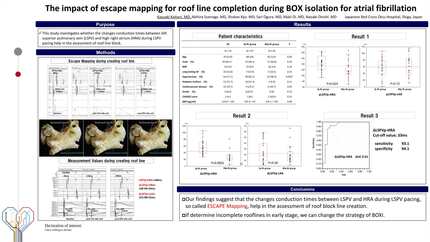
In this study, we investigate whether the changes conduction times from LSPV pacing to high right atrium (HRA) or from LSPV pacing to LAA help in the assessment of bi-directional roof line block.
76 de-novo non-paroxysmal AF patients underwent single ring protocol BOXI. The activation times were measured at HRA and LAA under LSPV pacing at baseline and after application for the roof line. Then we compared the change of activation time at HRA (∆LSPVp-HRA) at LAA (∆LSPVp-LAA) between the group that completed BOXI with the first-pass roof line group (fp-RL group) and non-first-pass roof line group (Nfp-RL group).
Among 76 patients, we achieved BOXI with fp-RL in the 46 patients. The mean ∆LSPVp-HRAfor fp-RL groupwas significantly longer than that of Nfp-RL group.∆LSPVp-HRA≥ 33ms predicted bi-directional roof line block with 93.1% sensitivity and 94.1% specificity, with 0.91 AUC.
Our finding suggests that the changes conduction times between LSPV and HRA during LSPV pacing, so called ESCAPE Mapping, help in the assessment of bi-directional roof block line creation. If determine incomplete rooflines in early stage, we can change the strategy of BOXI.
Contributors

You may be interested in