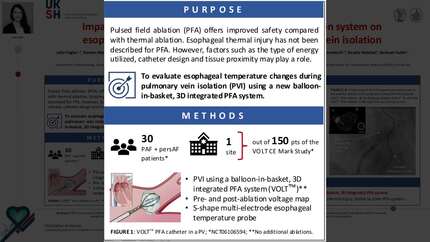
Impact of a new balloon-in-basket pulsed field ablation system on esophageal temperature changes during pulmonary vein isolation
EP Europace Journal


Abstract
Pulsed field ablation (PFA) for the treatment of atrial fibrillation (AF) offers improved safety compared with thermal ablation. Due to its myocardial tissue selectivity collateral tissue injury, especially esophageal thermal injury, potentially resulting in atrio-esophageal fistula have not been described for PFA. However, several factors such as energy utilized, catheter design and tissue proximity may play a role.
To evaluate potential esophageal temperature changes during pulmonary vein isolation (PVI) using a new balloon-in-basket, 3D integrated PFA system.
Thirty consecutive patients (median age 65 years; 60% male, 50% paroxysmal AF) out of 150 patients enrolled in the VOLT CE Mark Study (NCT06106594), a pre-market prospective, multi-center, single-arm study underwent de-novo AF ablation for symptomatic paroxysmal or persistent AF using a new balloon-in-basket PFA system at a tertiary care center. According to the protocol no additional ablations beyond PVI were allowed. Baseline therapy consisted of two nominal voltage applications with a maximum of eight applications per PV. A pre- and post-ablation voltage map was generated using a multipolar mapping catheter (HD grid) and a 3D-mapping system (Ensite X EP system). In this cohort, all procedures were performed under conscious sedation using Midazolam, Propofol and Fentanyl. Intraluminal esophageal temperature (TESO) was monitored continuously with an S-shaped multi-electrode esophageal temperature probe.
A mean of 16.5 ±2.0 PFA applications per subject and 4.2 ± 1.1 PFA applications per PV were delivered. Procedure, fluoroscopy, and LA dwell times were 78.2 ± 10.6 min, 10.0 ± 4.5 min and 27.1 ± 8.5 min, respectively. Mean TESO change was statistically significant and increased by 0.2 ± 0.1 °C, but was not clinically relevant (Table 1). No TESO increase > 1°C was observed. The highest TESO measured was 37.8°C and the largest TESO difference (DTESO) was 1.0°C. All patients remained asymptomatic considering possible esophageal thermal injury (ETI). No esophago-duodenoscopy was necessary.
PFA delivered via a new balloon-in-basket, 3D integrated PFA system demonstrated a clinically irrelevant TESO change. Thus, these results underline the potential of the PFA technology to possibly eliminate the risk of thermal damage to the esophagus. However, more studies with larger sample sizes are needed to draw robust conclusions and confirm these findings.
Table 1: Mean intraluminal esophageal temperature changes during pulmonary vein isolation using a new balloon-in-basket PFA system (n=30).
Contributors

J Vogler
Author
R Mamaev
Author
J P Wenzel
Author
C Eitel
Author
S S Popescu
Author
Z G Demirtakan
Author
T A Oezalp
Author
J Nikorowitsch
Author
S Hatahet
Author
B Subin
Author
S Reincke
Author
E Yaman
Author
M Kuechler
Author
K H Kuck
Author
R R Tilz
Author
You may be interested in