Impact of pre-procedural atrial fibrillation burden on recurrences after ablation: findings from the ISOLATION cohort study
EP Europace Journal


Abstract
Atrial fibrillation (AF) is usually categorized into paroxysmal, persistent and longstanding persistent AF. However, classification of AF on the actual burden of AF might better reflect the disease state of AF patients and improve clinical prediction models. Data on the benefit of pre-procedural AF burden based on single lead ECG measurements to predict AF recurrences after catheter ablation are scarce.
This study sought to assess the predictive performance of low versus high AF burden compared to the conventional AF classification for predicting recurrences after AF catheter ablation.
Patients with AF, who were scheduled for AF cryoablation or radiofrequency catheter ablation, were included in the prospective ISOLATION cohort study between July 2020 and November 2022 and followed up for 12 months after ablation. Clinical characteristics and routine diagnostics, together with rhythm monitoring through single lead ECGs were collected prior to ablation. Single lead ECGs were recorded three times daily for four weeks after baseline visitation, with additional recordings in case of the onset or relief of symptoms. Pre-procedural AF burden was defined as the number of recordings in AF divided by the total number of single lead ECGs performed. The primary endpoint was recurrence of atrial arrhythmia after the blanking period of three months until twelve months after ablation. Maximally rank statistics were used to determine the best cut-off value for AF burden.
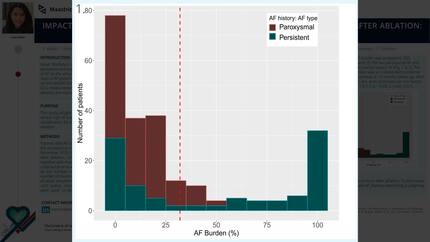
In 302 patients, pre-procedural rhythm monitoring and completed 12 month follow up after AF catheter ablation were available. The mean age was 64 ± 9 years, and 33% were female. Physicians classified 201 patients (67%) as having paroxysmal AF and 101 (33%) as having persistent AF based on medical history. For prediction of AF recurrences, the optimal calculated cut-off value for AF burden (high versus low) was 43% (Figure 1). After 12 months, in patients with persistent AF more recurrences occurred than in patients with paroxysmal AF (p= 0.01). Patients with high AF burden, had more recurrences after 12 months, than patients with a low AF burden (p < 0.001). Notably, paroxysmal AF patients with a high preprocedural AF burden had a similar recurrence rate as patients with persistent AF (Figure 2). Pre-procedural AF burden was an independent predictor of arrhythmia recurrence at 12 months follow-up, after correcting for age, sex, and cardiovascular risk factors (HR: 1.06; 95%CI: 1.0-1.1; p = 0.03), with a C-index of 0.66.
A high pre-procedural AF burden derived from single lead ECGs is an independent predictor of atrial arrhythmia recurrence after ablation. Furthermore, patients with paroxysmal AF and a high AF burden had a recurrence rate comparable to that of patients with persistent AF, thereby identifying a subgroup of patients with the paroxysmal AF patients with high risk for recurrences. Recurrences after 12 months
Contributors

Z Habibi
Author
D V M Verhaert
Author
K Betz
Author
B J M Hermans
Author
S Philippens
Author
S M Chaldoupi
Author
B Maesen
Author
J G Maessen
Author
A J Isaacs
Author
S W Westra
Author
R Nijveldt
Author
S Zeemering
Author
K Vernooy
Author
D Linz
Author
U Schotten
Author
You may be interested in