Characteristics of patients with isolated late recurrences after paroxysmal atrial fibrillation ablation - insights from the randomized COMPARE-CRYO study using continuous rhythm monitoring
EP Europace Journal


Abstract
Early recurrences of atrial tachyarrythmias (ERAT) after pulmonary vein isolation (PVI) are common. While many correlate to subsequent late recurrences of atrial tachyarrhythmias (LRAT, definition: after the blanking period between day 57 and 365 after PVI), some do not. In contrast, some patients develop isolated LRAT after the blanking period without preceding ERAT. The characteristics of patients with isolated LRAT, their temporal pattern of LRAT and the pathophysiological mechanisms involved are incompletely understood.
To characterize patients with isolated late recurrence (no ERAT, but LRAT) after PVI using implantable cardiac monitors (ICM) for continuous rhythm monitoring.
This sub study is derived from the randomized-controlled COMPARE-CRYO trial, which enrolled patients with paroxysmal atrial fibrillation undergoing cryoballoon ablation followed by ICM implantation at the end of the ablation. The duration of the blanking period used for this analysis was 8 weeks according to the recently updated recommendations.
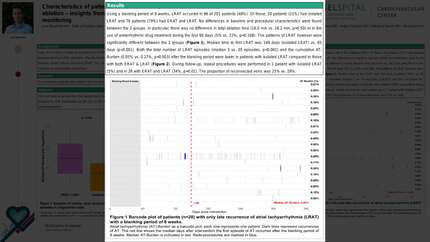
Using a blanking period of 8 weeks, LRAT occurred in 96 of 201 patients (48%). Of those, 20 patients (21%) had isolated LRAT and 76 patients (79%) had ERAT and LRAT. No differences in baseline and procedural characteristics were found between the 2 groups. In particular, there was no difference in total ablation time (16.0 min vs. 16.2 min, p=0.50) or in the use of antiarrhythmic drug treatment during the first 90 days (5% vs. 22%, p=0.108). The patterns of LRAT however were significantly different between the 2 groups (Figure 1). Median time to first LRAT was 149 days (isolated LRAT) vs. 65 days (p<0.001). Both the total number of LRAT episodes (median 3 vs. 20 episodes, p<0.001) and the cumulative AT-Burden (0.05% vs. 0.27%, p=0.003) after the blanking period were lower in patients with isolated LRAT compared to those with both ERAT & LRAT (Figure 2). During follow-up, redo-procedures were performed in 1 patient with isolated LRAT (5%) and in 26 with ERAT and LRAT (34%, p=0.01). The proportion of reconnected veins was 25% vs. 29%.
Patients with isolated LRAT after PVI represent a distinct subgroup with a significantly lower AT-Burden and need for redo-procedures compared to patients with both ERAT and LRAT. Clinical and procedural characteristics did not predict isolated LRAT. Further research is needed to determine the underlying mechanisms of isolated LRAT.
Contributors

J Maurhofer
Author
S Iqbal
Author
T Kueffer
Author
S Knecht
Author
P Badertscher
Author
P Krisai
Author
C Jufer
Author
G Thalmann
Author
N Kozhuharov
Author
H Servatius
Author
H Tanner
Author
M Kuehne
Author
L Roten
Author
C Sticherling
Author
T Reichlin
Author
You may be interested in