Prognostic effect of epicardial adipose tissue after atrial fibrillation catheter ablation: a metanalysis and systematic review
EP Europace Journal


Abstract
Although atrial fibrillation catheter ablation has been shown to be more effective than anti-arrhythmic drugs in maintaining sinus rhythm, recurrences after this procedure are common. Epicardial adipose tissue favors the development and progression of atrial fibrillation, and it has been hypothesized that it also increases the risk of atrial fibrillation catheter ablation failure.
The aim of this study was to systematically review the evidence on the effect of total or left atrial epicardial adipose tissue volume on atrial fibrillation catheter ablation and to perform a meta-analysis of the relationship between those volumes and catheter ablation failure.
The PubMed/MEDLINE databases were searched up to August 31, 2024 for articles reporting late recurrences of atrial fibrillation (90 days post catheter ablation) in patients who underwent both atrial fibrillation catheter ablation and total or left atrium epicardial adipose tissue volume assessment. Although epicardial adipose tissue can be quantified by different imaging techniques, only investigations relying on computed tomography were considered, since this is the mostly used method and is more accurate than echocardiography and more accessible than magnetic resonance imaging. Randomized controlled trials, prospective and retrospective studies were included.
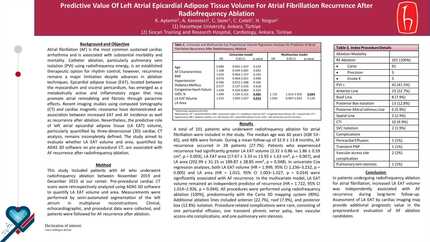
Twelve studies with left atrium epicardial adipose tissue data and sixteen with total epicardial adipose tissue data were included in the analysis, accounting for 3965 patients (66% male, 27% with persistent form, mean age 58.9 ± 10.5 years). During a mean follow-up of 18.4 months, recurrences occurred in 654 out of 1878 patients in whom left atrium epicardial adipose tissue was assessed and in 1323 patients out of 3805 in whom epicardial adipose tissue was assessed. The mean left atrium epicardial adipose tissue volume among patients with recurrence was 26.0 ± 12.6 mL, while among those free from recurrence it was 23.4 ± 10.8 mL. The mean epicardial adipose tissue volume among patients with recurrence was 125.2 ± 46.7 mL, while among those free from recurrence it was 114.4 ± 47.6 mL. Based on the random-effects model, the mean difference in left atrium and total epicardial adipose tissue volumes between patients free from recurrence and those with recurrence was statistically significant (−5.4 mL; 95% CI: −9.1 to −1.8 mL; p = 0.0034 and −13.9 mL; 95% CI: −23.6 to −4.2 mL; p = 0.005, respectively) (Figures 1a – 1b).
This meta-analysis indicates that higher volume of both total and left atrium epicardial adipose tissue is associated with more atrial fibrillation recurrence following catheter ablation. This finding may have clinical implications, as epicardial adipose tissue can be measured when cardiac CT is done to study left atria and pulmonary veins anatomy before atrial fibrillation catheter ablation. Standardized protocols for epicardial adipose tissue evaluation are needed. Studies evaluating LA EAT volume Studies evaluating EAT volume
Contributors

H Xhakupi
Author
A Ballatore
Author
M Anselmino
Author
P Di Donna
Author
G Mascia
Author
P Ameri
Author
I Porto
Author
You may be interested in