Pulsed field ablation of persistent and long-standing persistent atrial fibrillation: acute safety, efficacy and long-term outcome from a nationwide experience
EP Europace Journal


Abstract
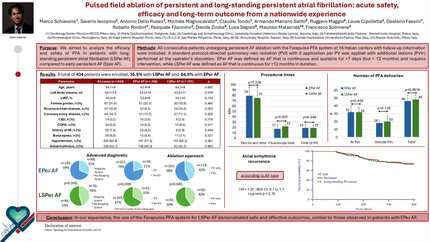
In patients with long-standing persistent (LSPer) atrial fibrillation (AF), the efficacy of catheter ablation remains limited, with long-term freedom from atrial arrhythmias typically reported at around 30% following a single procedure. Moreover, clinical evidence regarding the use of novel pulsed-field ablation (PFA) technology in this patient population is currently limited.
We aimed to analyze the efficacy and safety of PFA in patients with LSPer AF compared to early-persistent AF (Eper AF).
All consecutive patients undergoing persistent AF ablation with the Farapulse PFA system at 16 Italian centers with follow-up information were included. A standard protocol-directed pulmonary vein isolation (PVI) with 8 application per PV was applied with additional lesions performed at the operator’s discretion. EPer AF was defined as AF that is continuous and sustains for >7 days (but < 12 months) and requires intervention, while LSPer AF was defined as AF that is continuous for >12 months in duration.
Of 434 patients, 35.5% had LSPer AF, 20.9% were female, and the mean age was 64±9 years. A more extensive lesion set than PVI was performed in 58.3% of cases, with 18.4% being redo-AF procedures. In patients with LSPer AF a 3D mapping system (45.5% vs 31.4%, p=0.005) and an intracardiac echography (33.1% vs 21.1%, p=0.009) were employed more frequently than in patients with EPer AF, while a more extensive lesion set than PVI only was used in a similar way (59.7% vs 57.5%, p=0.685). No differences were found between groups in terms of PFA deliveries outside PVs (20[14-28] vs 18[14-22], p=0.126), total number of PFA deliveries (48[32-54] vs 46[32-54], p=0.0616), skin-to-skin time (75[65-95] min vs 79[65-95] min, p=0.326) or time to PVI (19[15-24] min vs 19[12-25] min, p=0.549), whereas fluoroscopy time was longer (22[17-25] min vs 17[13-24] min, p<0.001). PVI was achieved in all patients. During a median follow-up of 309[194-384] days, 87 (20%) of patients experienced an arrhythmic recurrence after the 90-day blanking period. The proportion of patient with LSPer AF who experienced a recurrence was similar to the ones with EPer AF (20.1% for LSPer AF vs 20% for EPer AF, odd ratio=1.01, 95%CI: 0.62 to 1.65, p=0.0974); LSPer AF was not associated to recurrences (hazard ratio=1.06, 95%CI: 0.68 to 1.66, log-rank p=0.785). No major complications (including death, renal failure, oesophageal complications, PV stenosis, persistent phrenic nerve injury) were reported.
In our experience, the use of the Farapulse PFA system for long-standing persistent AF demonstrated safe and effective outcomes, similar to those observed in patients with early persistent AF.
Contributors

M Schiavone
Author
S Iacopino
Author
A Dello Russo
Author
M Magnocavallo
Author
C Tondo
Author
A Salito
Author
R Maggio
Author
L Cipolletta
Author
G Fassini
Author
R Rordorf
Author
P Filannino
Author
D Zirolia
Author
L Segreti
Author
M Malacrida
Author
F Solimene
Author
You may be interested in