Evaluating cost effectiveness of pulmonary vein isolation modalities: a comparative analysis of material costs and staffing savings in pulsed field, cryoballoon, and radiofrequency ablation
EP Europace Journal


Abstract
Pulmonary vein isolation (PVI) is the key procedure in managing atrial fibrillation (AF), utilizing different ablation techniques: Pulsed Field Ablation (PFA), Cryoballoon (Cryo), and Radiofrequency (RF). Each modality has distinct cost and procedural efficiency profiles. Although PFA carries higher material costs than Cryo and RF, it significantly reduces procedure duration, potentially offsetting expenses through reduced staffing costs for physicians and nurses in the electrophysiology (EP) lab.
This study evaluates the cost-effectiveness of PFA compared to Cryo and RF, particularly in light of potential savings from reduced staff time.
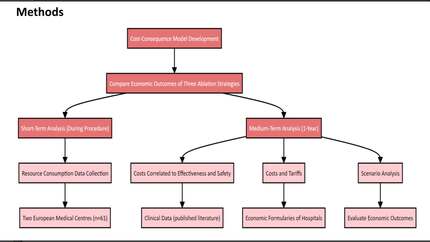
We retrospectively analyzed AF patients undergoing PVI between January 2024 and October 2024 in our center. The primary endpoint was total EP lab time, with secondary analysis focusing on adjusted costs accounting for procedural duration. Specifically, the study examined cost savings related to reduced physician and nursing time in the EP lab and the financial impact relative to RF.
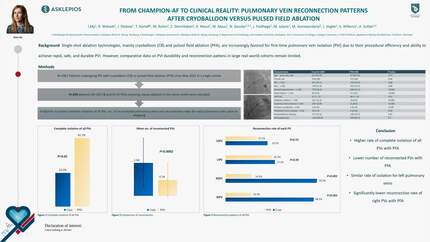
Of 467 patients (63% male, 45% PAF, 68±11 years) undergoing PVI, 133 were treated with PFA, 40 with Cryo, and 294 with RF. PFA patients spent an average of 101±22 min in the EP lab, compared to 156±39 min for Cryo and 195±61 min for RF (p<0.001). Accordingly, procedure duration was lower in PFA (41±12 min) than for Cryo (75±23 min) and RF (119±39 min) [p<0.001]. After accounting for reduced procedural time and the associated savings in physician and nursing costs, the per-procedure cost for PFA remained €721 higher than RF, while Cryo exceeded RF by €474 (p<0.001).
In our analysis the shorter lab time of PFA and Cryo did not result in an alignment to cost effectiveness to RF PVI but partly compensated for the higher costs for disposables. Though PFA incurs higher procedural costs compared to RF and Cryo, its shorter EP lab time offers cost-saving potential through reduced physician and nurse time, enhancing operational efficiency. Increased procedural capacity with PFA may also drive additional DRG revenue, which should be investigated in further large-scaled studies.
Contributors

J Woermann
Author
J H Van Den Bruck
Author
A Sultan
Author
J H Schipper
Author
J Ackmann
Author
F Pavel
Author
C Scheurlen
Author
S Dittrich
Author
J Lueker
Author
D Steven
Author
You may be interested in