Is pulmonary vein isolation assessment by a pentaspline catheter sensitive enough?
EP Europace Journal


Abstract
In recent studies, pulsed-field ablation (PFA) has shown excellent efficacy in pulmonary vein isolation (PVI). However, assessing PVI using only a pentaspline ablation catheter is often difficult, and a possibility of incomplete PVI has been described. This study aimed to assess the prevalence of acute PVI using a standard circular mapping catheter after PFA with a pentaspline ablation catheter.
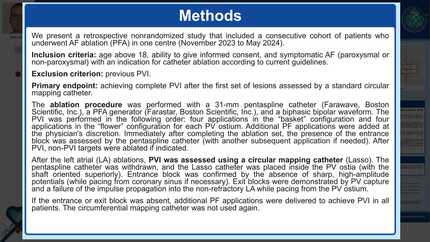
Patients treated with PFA for symptomatic atrial fibrillation (AF) were studied. At least 8 pulsed-field applications (4 in basket and 4 in flower configuration) were delivered to each pulmonary vein (PV) ostium. After completing the ablation set on each ostium, the PV was checked for isolation using the pentaspline ablation catheter. In cases of residual PV potentials, additional PF applications were added. After all ablations in the left atrium, all PVs were tested for entrance and exit block with a circular mapping catheter. Non-isolated PVs were treated with further PF applications to achieve a complete bidirectional block.
Out of 100 patients (400 PVs), an absence of an electrical isolation was observed in 15/400 PVs (3.8%), or 13/100 patients (13.0%) with a circumferential mapping catheter. There were eight left superior (53.3%), four right superior (26.7%), two left inferior (13.3%), and one right inferior (6.7%) PVs affected. Two patients presented with two non-isolated PVs (left superior and left inferior PV, and both superior PVs). All veins were completely isolated after the second set of applications.
Although PFA is an effective method for isolating PVs, there is a small yet non-negligible chance of incomplete PVI.
Contributors

Z Mrak
Author
M Hozman
Author
D Herman
Author
J Vesela
Author
J Karch
Author
L Poviser
Author
V Filipcova
Author
J Hozmanova
Author
P Osmancik
Author
You may be interested in