Echocardiographic features of the left ventricle in patients with atrial fibrillation after experiencing the coronavirus disease (COVID-19)
EP Europace Journal


Abstract
Echocardiography is an important, noninvasive test which helps to identify cardiac function and hemodynamic status. Left ventricular hypertrophy is a risk factor for adverse cardiovascular outcomes, including atrial fibrillation and COVID-19 potentiates cardiac injury.
To characterize echocardiographic signs of left ventricular hypertrophy in patients with atrial fibrillation after COVID-19.
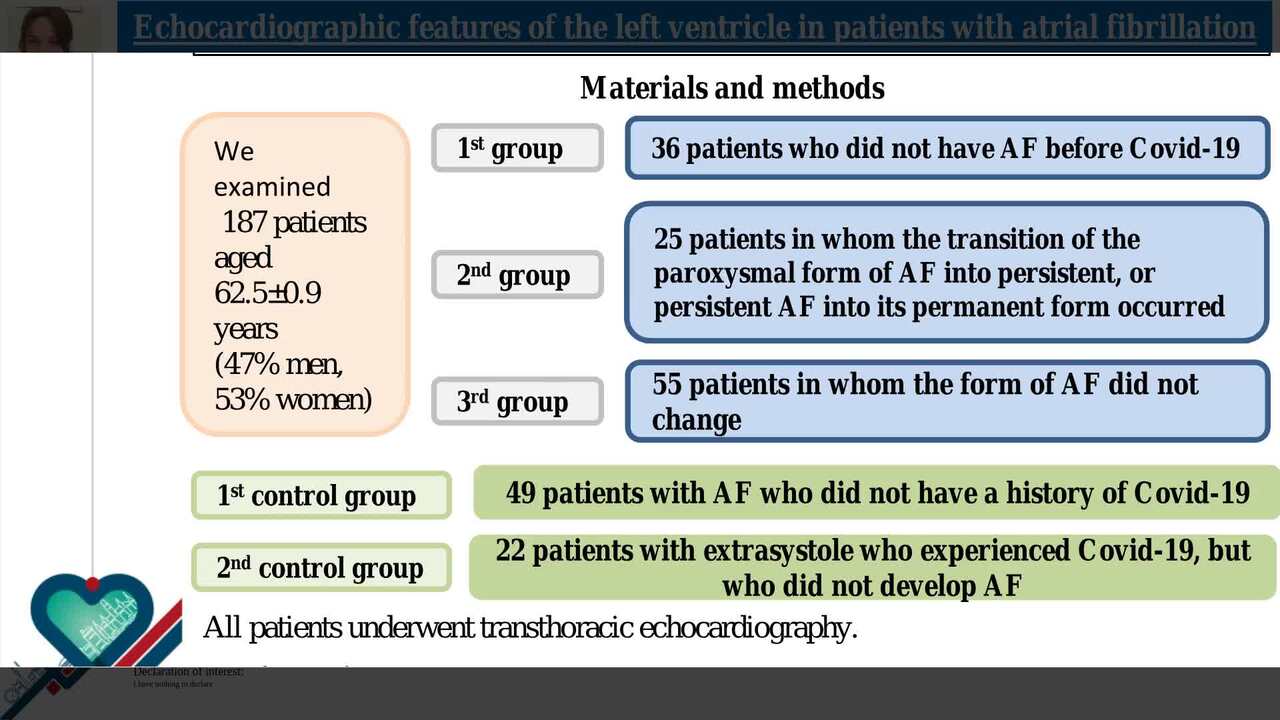
The study included 187 patients aged 62.5±0.9 years (47% men, 53% women). The first group consisted of 36 patients who did not have AF before Covid-19. The second group was represented by 25 patients in whom the transition of the paroxysmal form of AF into persistent, or persistent AF into its permanent form occurred. The third group consisted of 55 patients in whom the form of AF did not change. Two control groups were also formed: the first control group - 49 patients with AF who did not have a history of Covid-19, and the second control group - 22 patients with extrasystole who experienced Covid-19, but who did not develop AF. All patients underwent transthoracic echocardiography.
Interventricular septal thickness was 18.4% greater in patients who developed AF after COVID-19 compared to patients in whom the infection of COVID-19 did not cause the development of this arrhythmia (1.22 ± 0.03 vs 1.03 ± 0.14, p<0.02). The statistical validity of left ventricular myocardial mass index was verified between patients with atrial fibrillation who experienced COVID-19 and patients with AF who did not have the disease (101.3 ± 0.3 vs 97.8 ± 0.4, p<0.001). A difference in left ventricular mass index was recorded in patients who developed AF for the first time after COVID-19 compared to patients who had COVID-19 but did not develop AF (98.0 ± 0.5 vs71.9 ± 0.6, p<0.0001).
Hypertrophy of the interventricular septal thickness is a risk factor for the development of AF after COVID-19 and the cause of worsening of the course of this arrhythmia in patients who had it before the infection of COVID-19.
Contributors

O V Stasyshena
Author
O S Sychov
Author
O V Sribna
Author
T V Getman
Author
T V Mikhalieva
Author
A N Solovyan
Author
You may be interested in