Multimorbidity increases risk of cardiovascular outcomes in permanent atrial fibrillation: data from the RACE II study
EP Europace Journal


Abstract
Patients with atrial fibrillation (AF) frequently present with comorbidities. The prevalence of multimorbidity, defined as the presence of two or more chronic conditions in an individual, is therefore common in patients with AF. Previous studies have shown that the presence of multimorbidity in patients with AF is not only associated with increased risk of AF-related outcomes such as AF progression and AF symptom severity, but also adverse events and all-cause mortality. However data on its prevalence and impact in patients with permanent AF is limited.
This study aimed to investigate the prevalence of multimorbidity and its association with cardiovascular outcomes in patients with recent-onset permanent AF.
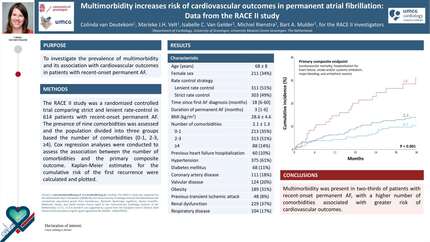
The RACE II study was a randomized controlled trial comparing strict and lenient rate-control in 614 patients with recent-onset permanent AF. Presence of nine comorbidities was assessed and the population divided into three groups based on the number of comorbidities present (0-1, 2-3, ≥4). Cox regression analyses were conducted to assess the association between the number of comorbidities and the primary composite outcome (cardiovascular mortality, hospitalisation for heart failure, stroke and/or systemic embolism, major bleeding, or arrhythmic events). Kaplan-Meier estimates for the cumulative risk of the first event were calculated and plotted.
Mean age was 68±8 years and 211 (34%) were women. In this population, 213 (35%) patients had 0-1 comorbidity, 313 (51%) 2-3 comorbidities, and 88 (14%) ≥4 comorbidities (Table 1). During 3 years follow-up, 81 patients (13%) reached the primary composite outcome. Patients with more comorbidities more frequently reached the primary composite outcome (P<0.001) (Figure 1), as well as the individual components cardiovascular mortality (P=0.049), heart failure hospitalisations (P=0.003), and stroke/systemic embolism (P=0.024). The presence of ≥4 comorbidities, adjusted for age, sex, and randomized rate-control strategy, was associated with a higher risk of the primary composite outcome compared to the presence of 0-1 comorbidity (HR 2.36, 95% CI (1.27-4.40), P=0.007).
Multimorbidity was present in two-thirds of patients with recent-onset permanent AF, with a higher number of comorbidities associated with greater risk of cardiovascular outcomes.
Contributors

You may be interested in