Discordance between different diagnostic criteria to assess probability of heart failure with preserved ejection fraction in patients with atrial fibrillation referred for catheter ablation
EP Europace Journal


Abstract
Heart failure with preserved ejection fraction (HFpEF) often coexists with atrial fibrillation (AF), but diagnosing HFpEF in patients with AF can be challenging as some HFpEF diagnostic criteria may be more related to AF itself than to HFpEF.
This study aimed to evaluate (1) the prevalence of HFpEF based on left atrial pressure (LAP) measurements in AF patients undergoing ablation; (2) predictors of HFpEF; (3) the concordance between LAP measurements and HFpEF risk scores; and (4) the impact of heart rhythm, ventilation type during ablation, and AF type on LAP values.
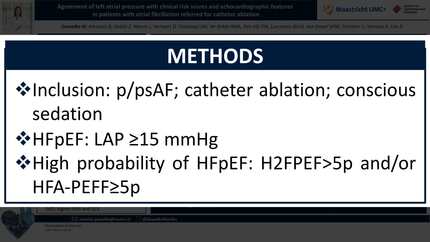
Consecutive symptomatic patients with paroxysmal or persistent AF scheduled for ablation were included. HFpEF was defined as a mean LAP ≥15 mmHg. A high probability of HFpEF was assigned to scores H2FPEF>5 and/or HFA-PEFF ≥5.
Among 381 participants (median age 65 [59-71] years, 41% female), 37% (n=140) had HFpEF based on LAP. In multivariable analysis, independent predictors of HFpEF included higher body mass index (BMI; OR 1.21, 95% CI 1.19-1.31) and lower LA reservoir strain (OR 0.97; 95% CI 0.94-0.99). Out of 381 patients, 325 (85%) had the necessary data to calculate HFpEF scores, with 34% (111/325) identified as high probability for HFpEF (H2FPEF >5 and/or HFA-PEFF ≥5). The H2FPEF score showed the highest agreement with elevated LAP. However, overall HFpEF scores had limited accuracy in predicting mean LAP ≥15 mm Hg, with an area under the curve (AUC) of 0.55 (95% CI 0.49–0.60) for HFA-PEFF ≥5, 0.58 (95% CI 0.53–0.63) for H2FPEF >5, and 0.58 (95% CI 0.53-0.64) for combined HFA-PEFF ≥5 and/or H2FPEF >5. Patients under general anesthesia (versus spontaneous breathing, 15 [11-17] vs 12 [9.0-15] mm Hg, p<0.001) and those without sinus rhythm (versus sinus rhythm, 14 [11-17] vs 12 [10-16] mm Hg, p=0.008) had higher LAP values, although these factors were not statistically significant in univariable analysis (non-sinus rhythm) or multivariable analysis (general anesthesia) for predicting HFpEF. AF burden by AF type was not associated with elevated LAP levels.
Over one-third of patients scheduled for catheter ablation met HFpEF criteria based on elevated LAP. Higher BMI and lower LA reservoir strain were significant predictors of HFpEF. Agreement between elevated LAP and HFpEF scores was generally low, with the H2FPEF score showing the best alignment. Non-sinus rhythm and general anesthesia were associated with higher LAP values, suggesting that HFpEF prevalence based on LAP may need careful interpretation, especially in studies focusing on patients under general anesthesia.
Contributors

M Gawalko
Author
Z Habibi
Author
D V M Verhaert
Author
J Weerts
Author
B Adriaans
Author
S M Chaldoupi
Author
R Ter Bekke
Author
D W Den Uijl
Author
J G L M Luermans
Author
V P M Van Empel
Author
U Schotten
Author
K Vernooy
Author
D Linz
Author
You may be interested in