Genetic and lifestyle risk factors preferentially strengthen recurrent ischemic stroke prediction in younger patients: data from the UK Biobank
EP Europace Journal


Abstract
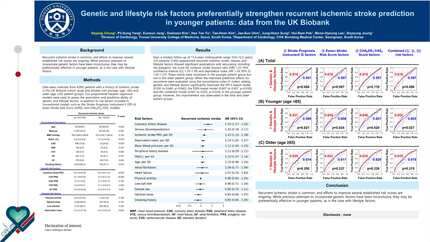
Recurrent ischemic stroke is common, and numerous prediction models have been suggested for its prediction. Whether genetic and lifestyle factors affect recurrence is unclear, and some studies have reported that these factors enhance prediction models preferentially in younger patients.
Data were collected from 4,092 patients with a history of ischemic stroke from the UK Biobank and divided into younger (age <65) and older (age ≥65) patient groups. Cox proportional hazards regression models were used to assess the association and predictive ability of genetic and lifestyle factors, in addition to the risk factors included in conventional models (Stroke Prognosis Instrument II, Essen Stroke Risk Score, and CHADS2-VASc models).
Over a median follow-up of 11.4 years (interquartile range [IQR], 10.6–12.3 years), 310 patients (7.6%) experienced recurrent ischemic stroke. The hazard ratio (HR) and concordance index (C-index) for recurrent ischemic stroke were most pronounced for coronary artery disease (1.55, 95% confidence interval [CI] 1.17–2.05) and HbA1c (0.602, 95% CI 0.567–0.638), respectively. Additionally, genetic and lifestyle risk factors also showed significant discriminative ability (C-index, 95% CI), such as the polygenic risk score for ischemic stroke (0.560, 0.527–0.593), deprivation index (0.549, 0.517–0.581), and physical activity (0.535, 0.502–0.569). Furthermore, genetic and lifestyle risk factors significantly improved the area under the receiver-operating characteristic curve of all conventional models and their combined models (0.605 to 0.652; p=0.027) in the younger patient group, but not in the total or older patient groups. Genetic and lifestyle risk factors also enhanced the C-index of the combined models only in the younger patient group (0.607 to 0.655; p=0.034).
Genetic and lifestyle risk factors preferentially affect ischemic stroke recurrence in younger patients. Prediction of recurrent ischemic stroke could be enhanced by incorporating genetic and lifestyle risk factors, particularly in younger patients. Ischemic stroke recurrence prediction

You may be interested in