Ketamine feasibility and safety in electrophysiological procedures: a pediatric cohort study
EP Europace Journal


Abstract
The anaesthetic management of patients undergoing electrophysiological (EP) procedures is a clinical challenge requiring careful balance between sedation, movement and pain control and haemodynamic stability. These aspects are pivotal in paediatric patients.
General anaesthesia (GA) is the standard of care during paediatric EP procedures, despite major limitations connected to the reduction in sympathetic activity that may consequently reduce sensitivity during EP study. Furthermore, GA implies an increased complexity for the perioperative management of the patient. Deep sedation using ketamine, has been proposed as an alternative in selected procedures, avoiding the need for endotracheal intubation and subsequent potential complications, facilitating faster post procedure recovery. However, its use in the paediatric population remains understudied and more research is needed.
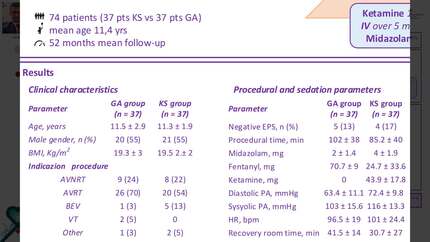
We retrospectively included paediatric (<18 y.o.) patients who underwent a first EP study between 2016 and 2024 in our Centre. Exclusion criteria were previous history or induction of ventricular tachycardia and known pre-existing structural heart conditions. The primary outcome was to assess short- and long-term effectiveness and safety of the ketamine EP procedures versus GA EP procedures. The secondary outcome was to assess the effect of ketamine sedation on electrocardiographic parameters.
Out of 368 patients, we identified seventy-four comparable patients. Thirty-seven ketamine-sedation (KS) paediatric patients (mean age 11.3 y, 55% male, mean BMI 19.5 kg/m2) were compared with thirty-seven consecutive (age= 11.5 y, 55% male, body mass index= 19.3 kg/m2) GA paediatric patients. In KS patients, an initial bolus of ketamine (1 mg/kg over 5 minutes) was injected (median 43.9 +/-17.8 mg) plus a maintenance infusion. No KS patient were converted in GA and no complications occurred during and after the KS anestesiological management (i.e. delirium or ALDRETE score <8). After the procedure, with a mean follow up of 4.3 years, 2/37 (5%) of the KS patients needed a second procedure for the index diagnosis, versus 5/37 (13%) of the GA patients (p value ns), confirming non inferiority for the KS tecnique.
Regarding our secondary outcome, there were no statistically significant differences in electrocardiographic parameters at baseline (pre ketamine infusion), during the EP study and at the end of procedure:
mean PR 127.5 +/-19 ms vs 124 +/-20 ms vs 133.9 +/-14.7 ms (p value ns)
mean QRSd 98.9 +/-13.3 ms vs 100.2 +/-13.5 ms vs 99.1 +/-13.8 ms (p value ns)
mean HR 101.5 +/-25.9 bpm vs 100.0 +/-24.2 bpm vs 105.0 +/-20.4 bpm (p value ns)
In our study, ketamine demonstrated an efficacy and safety profile comparable to that of general anesthesia, maintaining vital signs and electrocardiographic parameters in a stable range without compromising the quality or efficacy of the procedure.
Contributors

F Fioravanti
Author
S Gulletta
Author
F Caparra
Author
V Martello
Author
F Monaco
Author
J D'andria Ursoleo
Author
F M Cauti
Author
A Barengo
Author
G Peretto
Author
L Barca
Author
G Mascia
Author
A Zangrillo
Author
P Della Bella
Author
You may be interested in