Evaluation of the impact of using a steerable sheath and bubble filters on the incidence of asymptomatic brain lesions following atrial fibrillation (AF) ablation
EP Europace Journal


Abstract
Asymptomatic brain lesions are a common complication of AF ablation, with proposed mechanisms including air or steam embolism, plasma protein coagulation, and thrombus formation. This study aims to investigate whether the use of a steerable sheath for the ablation catheter and bubble filters can impact the incidence of asymptomatic brain lesions detectable by MRI after atrial fibrillation (AF) ablation.
The POWER FAST III study compared pulmonary vein ablation using conventional power delivered radiofrequency (CPD) with 25-40W versus high power (70W) and short duration (9–10s, HPSD). A cerebral MRI substudy was conducted on consecutive patients within <24 hours after ablation to detect acute ischemic brain lesions (DWI+ sequence). The effect of using or not using a steerable sheath (S+/S-) for the ablation catheter and bubble filters (F+/F-) in the perfusion lines (transseptal sheath, steerable sheath, and irrigation of the ablation catheter) was studied across 4 groups of consecutive patients (S+/F+, S+/F-, S-/F+, S-/F-) to assess the incidence of this complication.
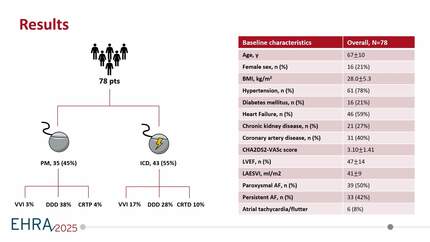
A total of 141 patients were included (60±11 years, 71% male, persistent AF 38%, CPD group 47%, and HPSD group 53%). The distribution by subgroup was S+/F+ 33 patients, S+/F- 52 patients, S-/F+ 43 patients, and S-/F- 13 patients. DWI+ lesions were detected in 58 (41%) patients, being more frequent in persistent AF cases (55% vs 45%, P=0.01) and in the HPSD group (67% vs 33%, P<0.01). The incidence of lesions by sheath and filter usage was: S+/F- 21 (40%), S+/F+ 13 (40%), S-/F+ 20 (46%), and S-/F- 4 (30%), P=0.77. Neither the use of a steerable sheath nor bubble filters, analyzed independently, was associated with a significantly different rate of brain lesions (V+ 40% vs V- 43%, P=0.74 and F+ 45% vs F- 38%, P=0.48).
The use of bubble filters and the avoidance of a steerable sheath do not reduce the incidence of asymptomatic brain lesions following atrial fibrillation (AF) ablation
Contributors

S Castrejon Castrejon
Author
B S V Sanz Verdejo
Author
M V R Maria Victoria Rossa
Author
P S S Paula Sanchez Somonte
Author
D S Davide Sorice
Author
R M Raul Moreno
Author
J L M Jose Luis Merino
Author
You may be interested in