Comparative outcomes of general anesthesia vs. conscious sedation in epicardial access for ventricular arrhythmia ablation: a 20-year analysis
EP Europace Journal


Abstract
Epicardial access for ventricular arrhythmia (VA) ablation has become integral, particularly in non-ischemic and arrhythmogenic right ventricular cardiomyopathy. General anesthesia (GA) or conscious sedation (CS) is typically employed to minimize patient discomfort and movement during epicardial access. This study aimed to identify key differences in baseline characteristics and procedural outcomes between patients undergoing GA or CS.
This study seeks to compare baseline characteristics, procedural details, and outcomes between patients receiving GA versus CS during epicardial access for VA ablation. Understanding these differences may inform procedural planning and patient selection to optimize outcomes.
Patients who underwent epicardial access for VA ablation from 2004 to 2024 were included. Baseline characteristics, procedural details, and outcomes were collected and compared using t-tests between GA and CS patients. Additionally, Kaplan-Meier survival analysis was conducted to compare survival in GA and CS groups, stratified by VA type (Ventricular Tachycardia (VT) and Premature Ventricular Complexes (PVC)).
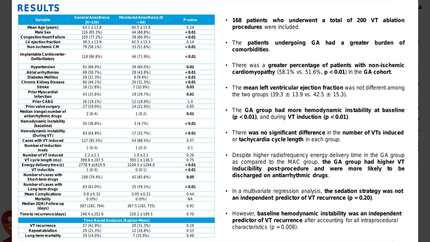
The study included 265 patients, with 148 receiving GA and 117 receiving CS. Significant differences in baseline characteristics were observed between the groups. CS patients had a higher ejection fraction (48.71% vs. 40.97%, p < 0.01) and a greater proportion of structurally normal hearts (35% vs. 8%, p < 0.01). GA patients had a higher comorbidity burden, including a greater prevalence of diabetes (21% vs. 10%, p = 0.02), heart failure (70% vs. 41%, p < 0.01), hypertension (48% vs. 33%, p = 0.01), device in-situ (80% vs. 50%, p < 0.01), and ischemic heart disease (25% vs. 12%, p = 0.01). PVC ablation was more common in CS patients (37% vs. 18%, p < 0.01). Fluoroscopy time was longer in CS patients (74.94 vs. 60.42 mins, p < 0.01), and GA patients required more ablation lesions (34.13 vs. 24.06, p < 0.01). Kaplan-Meier survival analysis showed no significant differences in survival between GA and CS groups for either VT or PVC. Complication rates and the combined endpoint of recurrence, heart transplant, or death also did not differ significantly between groups.
Patients undergoing epicardial access with GA had a higher burden of comorbidities and required more ablation lesions, while those with CS generally had better baseline cardiac function and were more frequently treated for PVCs. Although fluoroscopy time was longer in CS patients, complication rates and the combined outcome of recurrence, heart transplant, or death did not significantly differ between groups. Kaplan-Meier analysis further demonstrated similar survival outcomes between GA and CS groups for both VT and PVC. These findings suggest that both GA and CS can be safely used for epicardial access in VA ablation, with each approach tailored to the patient’s clinical profile and procedural needs.
Contributors

H Vemulapalli
Author
J F Rodriguez Riascos
Author
P Prajapati
Author
P Muthu
Author
A Raman
Author
K Srivathsan
Author
You may be interested in