Predictors of first pass isolation of the pulmonary veins with very high power short duration ablation protocol
EP Europace Journal


Abstract
Very high power short duration (vHPSD) ablation (90-W/4-second) for pulmonary veins facilitates faster procedural times. A hybrid ablation (90-W/4-second posteriorly; 50-W index >550 anteriorly) protocol is also proposed, combining this very high power modality with the existing conventional ablation strategy.
To identify the ablation parameters predicting a first pass isolation in the setting of a pulmonary vein encirclement with vHPSD and in a hybrid approach, using the QDOT Micro ablation catheter (Biosense Webster, Inc., Diamond Bar, CA, USA) and to compare them.
Consecutive patients who underwent isolation of the pulmonary veins for paroxysmal or persistent atrial fibrillation with vHPSD or hybrid ablation protocol were retrospectively enrolled from a single centre registry. Baseline and procedural characteristics of patients received vHPSD-ablation (vHPSD-Group) were compared to those ablated with the hybrid protocol (Hybrid-Group).
A total of 119 patients were enrolled; 75 (63%) in the vHPSD-Group and 44 (37%) in the Hybrid-Group. Baseline characteristics were comparable between the two groups.
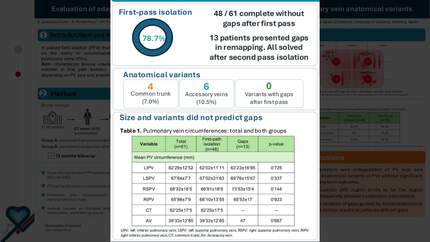
First pass isolation was totally achieved in 79 (66%) patients and did not differ significantly in both groups: 45 (61%) vs 33 (75%) for vHPSD and Hybrid-Group respectively; p=0.11.
442 (85%) veins were acutely isolated. Fifty-four veins required additional ablation index guided ablation.
Catheter stability (≤1,2mm), average force (≥11g) and inter-lesion (≤4,1mm) were significantly associated with first pass isolation in the vHPSD-Group.
In the Hybrid-Group, average force (≥12,5g) and impedance drop (≥9,7Ω) were significantly associated with first pass isolation.
However, only the catheter stability (≤1,2mm) proved to be significant in the vHPSD-Group compared to the Hybrid-Group in order to achieve first pass isolation.
First pass isolation with vHPSD ablation requires an enhanced catheter stability compared to the hybrid ablation protocol.
Contributors

V Varnavas
Author
A S Ceuppens
Author
S Marchandise
Author
Q Garnir
Author
A Wauters
Author
C Scavee
Author
You may be interested in