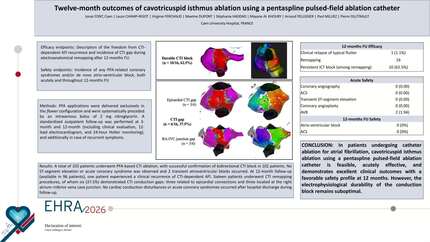
Ablation of the cavotricuspid isthmus with the pentaspline pulsed field ablation catheter
EP Europace Journal


Abstract
Pulsed field ablation (PFA) is a novel energy source for cardiac ablation. The pentaspline PFA catheter is the most widely used catheter and is designed to be a single-shot device for pulmonary vein isolation in patients with atrial fibrillation. The high co-incidence between atrial fibrillation and typical cavotricuspid isthmus (CTI) dependent atrial flutter may necessitate CTI ablation during PVI with the pentaspline PFA catheter.
We want to examine feasibility and safety of CTI ablation with the pentaspline PFA catheter and provide practical experiences from a large single-center patient cohort.
We included all patients who were scheduled for PVI with the pentaspline PFA catheter between 2021 and 2024 but intraprocedurally developed atrial flutter or had a history of atrial flutter and therefore also received CTI ablation with the same catheter. We analyzed procedural data, periprocedural complications, follow-up data and if available data from remapping procedures. Furthermore, we report our workflow with this catheter for CTI ablation and assessment of CTI block after the ablation.
A total of 40 patients met criteria for inclusion (mean age 68 years, 75% male). Mean procedure time including PVI was 43 minutes. CTI block was successfully achieved in 39 cases (97.5%). The 31 mm device was used in 35/40 (87.5%) and the 35 mm device in 5/40 (12.5%) cases. Number of pulsed field applications at the CTI ranged from 2 to 12 (median 5). Mean dose of nitroglycerin administered intravenously before ablation was 0.43 mg. No case of coronary vasospasm and no other periprocedural complication occurred.
Follow-up data was available for 30/40 patients (75%) with a median follow-up time of 174 days. Recurrence of atrial tachyarrhythmia was recorded in 5/30 patients (17%). Type of recurrence was atrial fibrillation in 4 patients. On e patient experienced recurrence of CTI dependent atrial flutter 149 days after the index procedure, during which the initial CTI ablation was successful. We performed a repeat procedure and confirmed recovery of conduction at the CTI.
Despite being designed for PVI, the pentaspline PFA catheter can also be safely and efficiently used for CTI ablation. Manipulation at the CTI can be complicated due to the size of the device. We recommend complete bending of the steerable sheath to face the CTI with a flat flower configuration (Figure 1). For assessment of a successful block after the ablation, the pentaspline catheter can be put into the coronary sinus over the wire and a diagnostic decapolar catheter can be placed in the lateral right atrium (Figure 2a). Alternatively, the pentaspline catheter can be positioned at the RA septum for pacing (Figure 2b). More remapping data is needed to assess durability of the CTI lesions. Catheter placement Block assessment
Contributors

J Kheir
Author
D Schaack
Author
L Urbanek
Author
S Tohoku
Author
J Hirokami
Author
A Urbani
Author
D Garattini
Author
S Bordignon
Author
A Marrese
Author
A Steyer
Author
B Schimidt
Author
J Chun
Author
You may be interested in