Acute and long-term results of atrial fibrillation cryoablation guided by pressure waveforms: a multicentre registry
EP Europace Journal


Abstract
Cryoballoon ablation (CA) procedures require optimal occlusion of the pulmonary veins (PV), which is conventionally evaluated by contrast injection through the catheter tip. This technique has some weaknesses such as risk of allergic reactions, nephrotoxicity, requirement of a second operator, among others. PV pressure waveform analysis is an alternative method for confirming occlusion, however, multicentre assessment of periprocedural efficacy and safety is lacking.
To describe the intra-procedural performance, safety and long-term results of routine pressure-based CA.
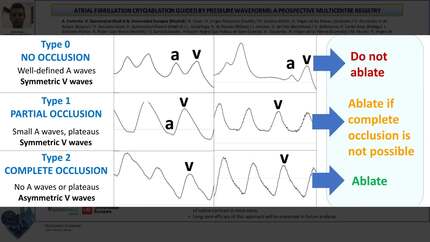
In this independent prospective multicentre and multi-brand observational study, baseline, procedural and follow-up data from consecutive pressure-guided cryoballoon ablations were collected. Pressure waveforms were classified into type 1 (presence of "a-wave" and/or symmetric "v-wave", meaning incomplete PV occlusion) and type 2 (absence of "a-wave" and asymmetric "v-wave", meaning complete PV occlusion).
A total of 235 patients (mean age: 61 ± 10 y.) with paroxysmal (57.8%) or persistent AF (42.2%) from 9 centres were enrolled. Complete PV isolation was achieved in 226 patients (97%). The operators switched to contrast in 16 cases (6.8%). Thirteen non-serious (5.5%) and 0 serious procedure-related adverse events were reported. AF/AT-free survival rate after the index procedure was 60.3% after a median follow-up of 359 days. Ten patients (4.3%) required a second procedure.
Routine PV cryoablation guided exclusively by pressure waveforms was safe and could be achieved in most of the patients. No contrast requirement and a high single shot isolation rate (78%) were important advantages of this approach. Long-term clinical efficacy was equivalent to that reported with the conventional approach. Pressure waveforms classification Catheters,procedural & clinical outcomes
Contributors

A Fontenla Cerezuela
Author
R Cozar Leon
Author
P J Sanchez-Millan
Author
G Fernandez Palacios
Author
D Gonzalez Casal
Author
L Gaztanaga Arantzamendi
Author
J I Jimenez Lopez
Author
G Ballesteros
Author
J Gonzalez Panizo
Author
J Medina Suarez
Author
A Izquierdo Bajo
Author
M Alvarez Lopez
Author
N Soto Flores
Author
J A Cabrera Rodriguez
Author
T Datino Romaniega
Author
You may be interested in