Comparative analysis of femoral vein access techniques in atrial fibrillation ablation: reducing groin complications with ultrasound-guided micropuncture
EP Europace Journal


Abstract
Atrial fibrillation (AF) is the most common cardiac arrhythmia, often resulting in symptoms such as palpitations, fatigue, and shortness of breath. Catheter ablation is a widely used treatment for AF, involving the use of heat, cold, or electrical energy to destroy the heart tissue responsible for irregular rhythms. The procedure typically requires femoral vein access, and groin-related complications are the most common adverse events.
This study aimed to evaluate the safety of AF ablation by assessing the impact of ultrasound guidance and micropuncture techniques on reducing groin complications during femoral vein access.
This retrospective registry-based study included patients who underwent AF ablation between January 1, 2015, and December 31, 2022, at Sahlgrenska University Hospital. Patients were categorized into three groups based on the femoral access technique used: manual palpation, ultrasound guidance, and ultrasound with micropuncture.
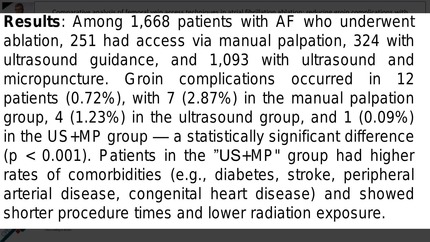
A total of 1,668 patients underwent AF ablation, with 251 in the manual palpation group, 324 in the ultrasound group, and 1,093 in the ultrasound with micropuncture group. Groin complications occurred in 12 patients (0.72%) overall: 7 (2.87%) in the palpation group, 4 (1.23%) in the ultrasound group, and 1 (0.09%) in the ultrasound with micropuncture group. The difference in complication rates between the groups was statistically significant (p<0.001). Patients in the ultrasound with micropuncture group were generally sicker, with higher rates of comorbidities such as diabetes, stroke, and lower ejection fractions (EF <50%). These patients also had shorter procedure times and reduced radiation exposure.
This study demonstrates that the combination of ultrasound guidance and micropuncture significantly reduces the incidence of groin complications in AF ablation procedures. This appears to be the first investigation into the use of micropuncture techniques specifically for venous access in AF ablation, with promising results. Further studies are needed to confirm these findings and validate the clinical benefits of this technique.
Contributors

R Sigurjonsdottir
Author
S Dabak
Author
A Rubulis
Author
O Bene
Author
H U Uuetoa
Author
P Gudjonsson
Author
C Herczku
Author
D Isakssen
Author
K J Axelsson
Author
You may be interested in