Efficacy and drug-related complications of anticholinergic drugs for vagal reaction prevention during pulsed field ablation
EP Europace Journal


Abstract
Vagal responses (VR) are frequently observed during pulmonary vein isolation (PVI) with pulsed field ablation (PFA).
To compare the effectiveness of two different anticholinergic (AC) medications, namely Glycopyrrolate (GLY) or Atropine (ATP), for VR prophylaxis in patients undergoing PVI via a pentaspline PFA catheter.
Consecutive AF patients undergoing first-time PVI with PFA were prospectively enrolled at four centres between April 2023 and February 2024. Intravenous GLY 0.2mg [Group GLY] or Atropine 1mg [Group ATP] were administered prophylactically before transseptal access. Clinically relevant VRs included sinus bradycardia (<40 beats/min), asystole (>6 sec), atrioventricular block (AVB), need for temporary backup pacing. The incidence of periprocedural VRs was compared with that of patients without prophylactic AC drug administration (Group noAC). Drug-related adverse events were compared between the two anticholinergic drugs.
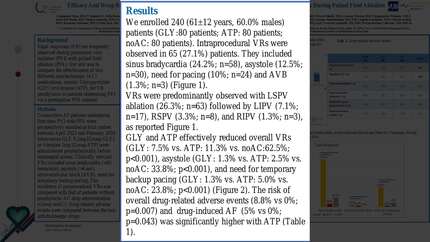
We enrolled 240 (61±12 years, 60.0% males) patients (GLY:80 patients; ATP: 80 patients; noAC: 80 patients). Intraprocedural VRs were observed in 65 (27.1%) patients. GLY and ATP effectively reduced overall VRs (GLY: 7.5% vs. ATP: 11.3% vs. noAC:62.5%; p<0.001), asystole (GLY: 1.3% vs. ATP: 2.5% vs. noAC: 33.8%; p<0.001), and need for temporary backup pacing (GLY: 1.3% vs. ATP: 5.0% vs. noAC: 23.8%; p<0.001). The risk of overall drug-related adverse events (8.8% vs 0%; p=0.007) and drug-induced AF (5% vs 0%; p=0.043) was significantly higher with ATP.
Prophylactic AC drug administration effectively prevented clinically relevant VRs in patients undergoing PVI with PFA. Both AC drugs were equally highly effective, but ATP was associated with a significantly higher risk of drug-induced adverse events.
Contributors

G Vetta
Author
D G Della Rocca
Author
M Magnocavallo
Author
R Richard-Vitton
Author
A Almorad
Author
A Del Monte
Author
L Marcon
Author
P Rossi
Author
K Nakasone
Author
L Pannone
Author
A Natale
Author
S Boveda
Author
A Sarkozy
Author
C De Asmundis
Author
G B Chierchia
Author
You may be interested in