Biomarker release and haemolysis among three different pulsed field ablation strategies
EP Europace Journal


Abstract
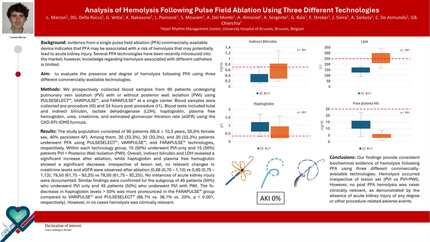
Pulsed field ablation (PFA) has emerged as an innovative technique for treating atrial fibrillation (AFib), utilizing electric fields to selectively ablate cardiac tissue while minimizing damage to surrounding structures. Different PFA systems may result in varying levels of biomarker release and haemolysis, potentially impacting procedural outcomes and patient safety. The aim of the study is to evaluate the initial findings on biomarker release and haemolysis among 3 different PFA systems.
This prospective, randomized study including patients undergoing pulmonary vein isolation due to paroxysmal and persistent AFib, compared 3 PFA systems: Varipulse (Group V, N=8), Pulseselect (Group P, N=10), and Farapulse (Group F, N=12) focusing on the release of biomarkers associated with myocardial injury (high-sensitive troponin T (hs-cTnT), myoglobin), inflammatory response (C-reactive protein [CRP]), and indicators of haemolysis (haemoglobin, bilirubin, lactate dehydrogenase (LDH)). Biomarker levels were measured before the procedure, 4 and 24 hours after. In all 3 groups the ablation was done according to the companies' recommended protocols regarding the number of PFA applications.
The mean age in the study population was 58 ±12 years, 50% paroxysmal AFib. After 24 hours haemoglobin levels significantly decreased in Group V (-6.0%), Group P (-6.9%), and Group F (-10.5%), without significant difference between groups (p= 0.342). Bilirubin levels increased significantly in all 3 groups (Group V 15.4% vs Group P 5.3% vs. Group F 58.3%), with Group F showing a significantly larger increase (p= 0.020). LDH levels increased significantly in Group P (50.6%) and Group F (38.6%) compared to Group V (27.6%) (p= 0.038). CRP levels increased significantly by 60% in Group V, 189.6% in Group P, and 385.2% in Group F, without significant differences between groups (p= 0.920). Myoglobin levels increased significantly in all groups (V 76.7% vs. P 56.1% vs. F 38.9%), without significant differences between the groups (p= 0.732). Hs-cTnT levels increased significantly in all groups (V 93337% vs. P 235080% vs. F 244780%), without significant differences between groups (p= 0.128).
The choice of PFA system has some impact on biomarker release and haemolysis levels. Farapulse (Group F) demonstrated the highest increases in bilirubin and CRP levels, indicating a greater inflammatory response and haemolytic effect. Further studies are needed to explore both short- and long-term implications of these differences in clinical practice.
Contributors

I B Ivica Benko
Author
S S T Sanda Sokol Tomic
Author
N B Niksa Busic
Author
S M Sime Manola
Author
N P Nikola Pavlovic
Author
I Z Ivan Zeljkovic
Author
A Jordan
Author
A L Ante Lisicic
Author
You may be interested in