Real-world experience of atrial fibrillation ablation using a variable-loop circular catheter: a single-centre study
EP Europace Journal


Abstract
The Variable-Loop Circular Catheter (VLCC) is a bidirectional multi-electrode catheter capable of electroanatomical mapping and pulsed field energy (PF) delivery for the treatment of atrial fibrillation (AF).
to report first experience with VLCC for AF ablation in a high-volume centre experienced with single-shot PF devices.
Consecutive AF patients undergoing AF ablation with VLCC were prospectively enrolled in our centre between April 2024 and October 2024. Pulmonary vein isolation (PVI) was performed using at least 16 applications per vein. The primary efficacy endpoint included acute electrical isolation of pulmonary veins (PVs) or posterior wall (PW) and bidirectional block in case of linear lesions. The primary safety endpoint was composite of periprocedural device-related major adverse events.
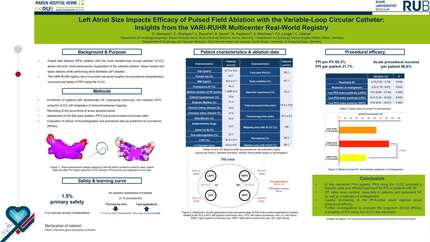
We enrolled 32 (63.6 ± 10.2 years, 50% males, 28.1% Persistent AF) patients and a total of 130 PVs. All patients underwent PVI, 31.3% underwent PW isolation and 9.4% underwent additional lesions with VLCC (1 Cavotricuspid isthmus, 1 roof line and 1 anterior mitral line ablation). In 34.4% of the patients, deflectable sheath was used, while in the remaining 65.6% patients a fixed sheath was employed. Median procedural time was 60 min (50-90), dwelling time 30 min (25-50) and fluoroscopy time 5 min (3-10). Primary efficacy endpoint was reached in 100% of patients for PVI, PW and additional lesions (Figure 1). First Pass Isolation rate was 96.2% for PVI (LSPV: 100%; LIPV: 93.5%; RSPV: 90.1%; RIPV: 96.9%) and 80% for PW isolation (Figure 1). The integrated VLCC electroanatomic mapping system allowed mapping of 4 different atrial tachycardias (1 double loop AFL, 2 CTI-dependent AFL and 1 crista terminalis atrial tachycardia). No safety endpoint occurred.
AF ablation via a novel VLCC confirmed high efficacy and safety in a real-world scenario.
Contributors

A Almorad
Author
G Vetta
Author
D G Della Rocca
Author
C Audiat
Author
L Marcon
Author
V Pasara
Author
T Sattin
Author
K Nakasone
Author
L Pannone
Author
J Sieira
Author
E Stroker
Author
G Bala
Author
A Sarkozy
Author
C De Asmundis
Author
G B Chierchia
Author
You may be interested in