The effect of different ablation modalities for atrial fibrillation on left atrial remodeling and function
EP Europace Journal


Abstract
Pulmonary vein isolation (PVI) is one of the corner stones of therapy for atrial fibrillation. New ablation technologies using pulsed field (PFA) energy are emerging as a promising alternative to conventional radiofrequency (RFA) energy. The effect on left atrial (LA) function of this energy form however has not been well described.
The aim of this study is to examine the effect of PVI with RFA or PFA on LA remodeling and mechanical function in patients with paroxysmal atrial fibrillation (PAF).
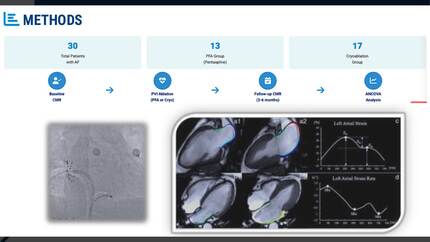
This is a single center prospective study that included patients who were scheduled for a first ablation in the form of PVI because of PAF. The choice between PFA or RFA was made on a random basis. In the PFA group, PVI was performed using a multi-electrode pentaspline PFA catheter. In the RFA group, a conventional focal, solid tip, contact force sensing irrigated ablation catheter with radiofrequency energy was used. Included patients underwent serial dedicated echocardiograms with a focus on LA function using strain analyses: one baseline echo just before the procedure, one in the acute phase just after the procedure and one in the chronic phase at three months follow-up. Image quality had to be sufficient to allow for appropriate strain analyses.
We included 28 patients in the RFA and 31 in the PFA group. Baseline characteristics in both groups were comparable, as can be seen in the table provided. Follow-up strain data were available in the acute phase for 22 patients in the RFA group and 27 in the PFA group. In the chronic phase, these were available in 26 and 29 patients respectively. In the RFA group, LA reservoir strain (LASr) as well as contraction strain (LASct) values did not differ significantly between the baseline and acute phase (23,7 ±7,5% vs 23,0 ±7,7%, p=0,571 and 11,1 ±4,7% vs 9,6 ±4,1%, p=0,085, respectively), and they remained unchanged in the chronic phase as compared to baseline (25,4 ±7,3% vs 25,4 ±7,5%, p=0,567 and 11,4 ±4,7% vs 12,0 ±4,7%, p=0,364, respectively). In the PFA group however, LASr as well as LASct were reduced significantly in the acute phase (26,5 ±5,8% vs 22,9 ±6,6%, p=0,010 and 12,2 ±3,6% vs 8,6 ±3,1%, p<0,001, respectively). In the chronic phase, LASr recovered to the baseline value (26,5 ±5,7% vs 25,8 ±7,9%, p=0,213), LASct remained significantly reduced (12,4 ±3,6% vs 10,9 ±4,3%, p=0,031).
In the acute phase after PVI by PFA, there is an effect of LA stunning as is evidenced by a reduction in both LASr as well as in LASct, which is not seen after PVI in the RFA group. In the chronic phase after PFA, global LA function seems to recover as is evidenced by normalization of LASr, the atrial contraction however is still reduced which is not the case in the RFA group. This might indicate that PVI with PFA causes some degree of atrial dysfunction which is not seen after RFA. Baseline characteristics Results

You may be interested in