Grid annotation vs. ablation tags in predicting lesion area coverage for pulmonary vein isolation using a variable-loop circular catheter
EP Europace Journal


Abstract
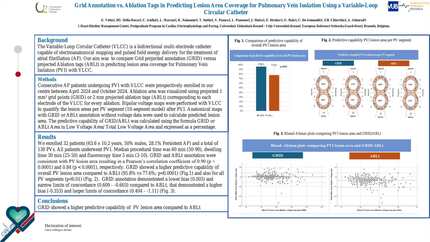
The Variable-Loop Circular Catheter (VLCC) is a bidirectional multi-electrode catheter capable of electroanatomical mapping and pulsed field energy delivery for the treatment of atrial fibrillation (AF).
to compare Grid projected annotation (GRID) versus projected Ablation tags (ABLt) in predicting lesion area coverage for Pulmonary Vein Isolation (PVI) with VLCC.
Consecutive patients with AF who underwent PVI with VLCC were prospectively enrolled in our center between April 2024 and October 2024. Ablation area was visualized using projected 1 mm³ grid points (GRID) or 2 mm projected ablation tags (ABLt) corresponding to each VLCC electrode for every ablation. Bipolar voltage maps were performed with VLCC to quantify the lesion areas per PV segment (10-segment model) after PVI. Anatomical maps with GRID or ABLt annotation without voltage data were used to calculate predicted lesion area. The predictive capability of GRID/ABLt was calculated using the formula GRID or ABLt Area in Low Voltage Area/ Total Low Voltage Area and expressed as a percentage.
We enrolled 32 patients (63.6 ± 10.2 years, 50% males, 28.1% Persistent AF) and a total of 130 PVs. All patients underwent PVI. Median procedural time was 60 min (50-90), dwelling time 30 min (25-50) and fluoroscopy time 5 min (3-10). GRID and ABLt annotations were consistent with PV lesion area resulting in a Pearson’s correlation coefficient of 0.90 (p < 0.0001) and 0.84 (p < 0.0001), respectively. GRID showed a higher predictive capability of overall PV lesion area compared to ABLt (95.8% vs 77.6%; p<0.0001) irrespective to PV segments (p<0.01) (Figure 1). GRID annotation demonstrated a lower bias (0.003) and narrow limits of concordance (0.609 - -0.603) compared to ABLt demonstrated a higher bias (-0.353) and larger limits of concordance (0.404 - -1.11) (Figure 1).
GRID showed a higher predictive PV lesion area evalutation compared to ABLt.
Contributors

G Vetta
Author
D G Della Rocca
Author
C Audiat
Author
L Marcon
Author
K Nakasone
Author
T Sattin
Author
V Pasara
Author
L Pannone
Author
J Sieira
Author
E Stroker
Author
G Bala
Author
C De Asmundis
Author
G B Chierchia
Author
A Almorad
Author
You may be interested in