Predictors of hemodynamic and respiratory instability during deep sedation for left atrial ablation: preliminary results from a retrospective german cohort
EP Europace Journal


Abstract
Deep sedation is increasingly used in left atrial ablations, especially with pulsed field ablation (PFA), which demands deeper sedation than traditional thermal ablation. This trend raises new safety concerns and highlights the need for standardized sedation protocols, with currently no existing consensus in Europe.
This study aims to identify predictors of hemodynamic and respiratory instability during left atrial ablation under deep sedation, helping the development of standardized sedation protocols.
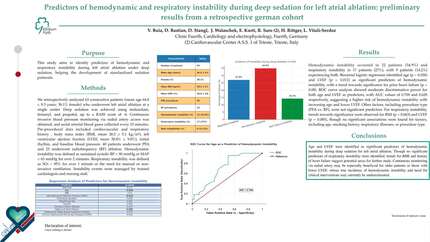
We retrospectively analyzed 63 consecutive patients (mean age 64.8 ± 9.3 years; 38.1% female) who underwent left atrial ablation at a single center. Deep sedation was achieved using midazolam, fentanyl, and propofol, up to a RASS score of -4. Continuous invasive blood pressure monitoring via radial artery access was obtained, and serial arterial blood gases collected every 15 minutes. Pre-procedural data included cardiovascular and respiratory history , body mass index (BMI, mean 28.5 ± 5.1 kg/m²), left ventricular ejection fraction (LVEF, mean 58.8% ± 9.8%), initial rhythm, and baseline blood pressure. 40 patients underwent PFA and 23 underwent radiofrequency (RF) ablation. Hemodynamic instability was defined as sustained systolic BP < 90 mmHg or MAP < 65 mmHg for over 2 minutes. Respiratory instability was defined as SO2 < 85% for over 1 minute or the need for manual or non-invasive ventilation. Instability events were managed by trained cardiologists and nursing staff.
Hemodynamic instability occurred in 22 patients (34.9%) and respiratory instability in 17 patients (27%), with 9 patients (14.2%) experiencing both. Binomial logistic regression identified age (p = 0.034) and LVEF (p = 0.012) as significant predictors of hemodynamic instability, with a trend towards significance for prior heart failure (p = 0.08). ROC curve analysis showed moderate discriminative power for both age and LVEF as predictors, with AUC values of 0.709 and 0.628 respectively, suggesting a higher risk of hemodynamic instability with increasing age and lower LVEF. Other factors, including procedure type (PFA vs. RF), were not significant predictors. For respiratory instability, trends towards significance were observed for BMI (p = 0.063) and LVEF (p = 0.085), though no significant associations were found for factors, including age, smoking history, respiratory illnesses, or procedure type.
Age and LVEF were identified as significant predictors of hemodynamic instability during deep sedation for left atrial ablation. Though no significant predictors of respiratory instability were identified, trends for BMI and LVEF suggest potential areas for further study. Continuous monitoring via radial artery may be especially beneficial for older patients or those with lower LVEF, whose true incidence of hemodynamic instability and need for clinical interventions may currently be underestimated.
Contributors

V Buia
Author
D Bastian
Author
D Stangl
Author
J Walaschek
Author
E Kurti
Author
R Saro
Author
H Rittger
Author
L Vitali-Serdoz
Author
You may be interested in